
This post contains affiliate links. We may earn a small commission when you buy through our links — at no extra cost to you.
Window fans look nearly identical on the shelf: twin blades, expandable panels, and a CFM number. After a few nights in a bedroom, the differences surface — low-speed hum, thermostat cycling, and a ‘reversible’ setting that sometimes means flipping the entire fan. For sleep, low-speed noise matters more than peak air movement.
That creates a real trade-off between raw airflow and night-friendly control. A high-velocity twin fan moves more air, but often adds an electrical hum on low and skips the remote. A remote thermostat model is easier to adjust from bed, yet its electronics carry more reliability concerns. Decide which compromise fits your room before shopping.
The right pick depends on your window size, how hot your room gets, and whether you want to change directions without getting up. This guide frames those choices as use-case decisions: what to pay for, what to ignore, and what to expect after a full summer.
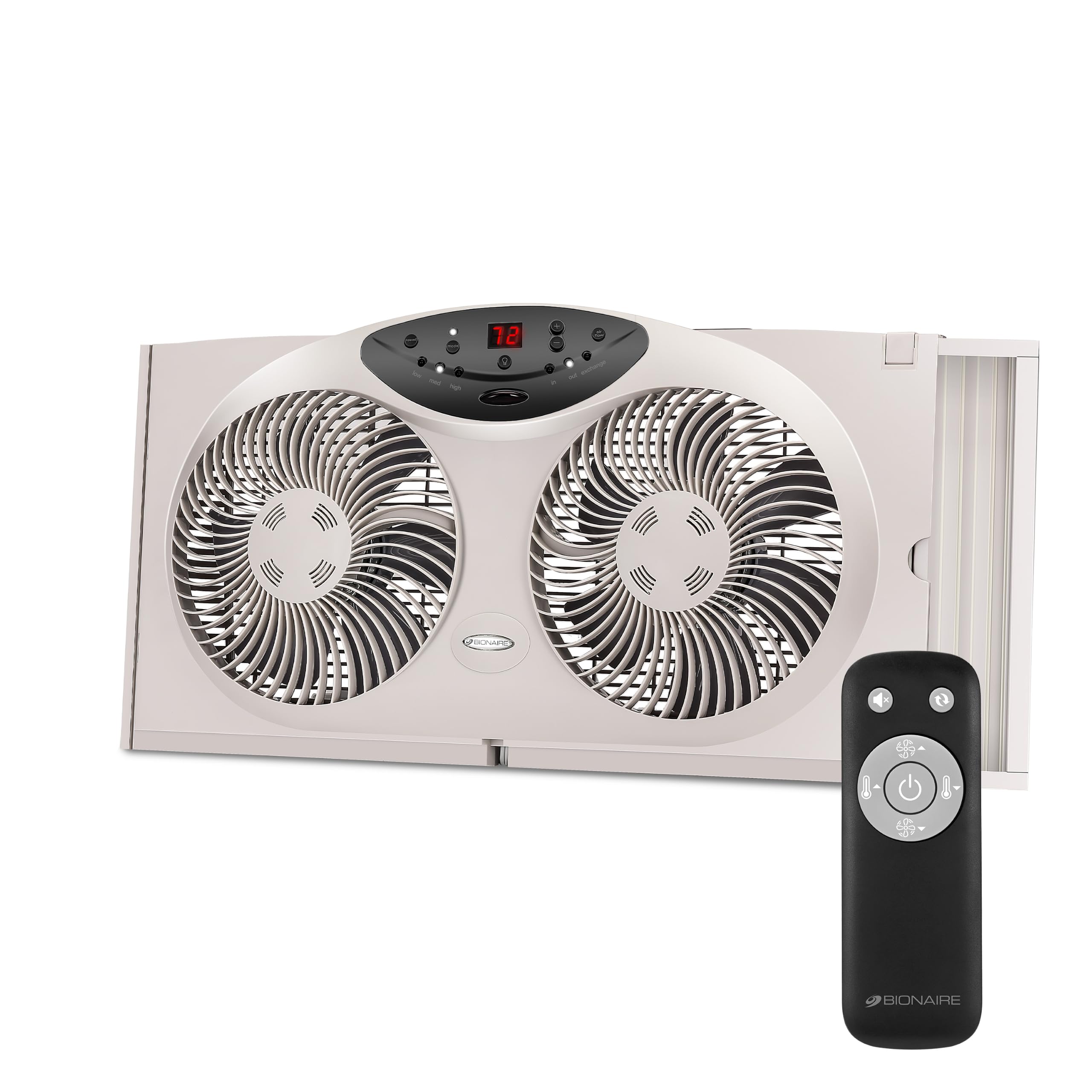


Best for Most Bedroom Owners
Bionaire Digital Window Fan
Key Features
- Airflow & CFM: Dual 8.5-inch blades
- Reverse Type: Electronic
- Window Fit: 24-36 in.
- Remote / Thermostat: Remote + thermostat
- Price: Mid-Range
The Bionaire Digital Window Fan puts the controls a bedroom setup needs in one package: a remote that works from the pillow, a thermostat that can shut the fan off once the room cools, and electronic reverse that changes intake to exhaust without touching the unit. Low speed holds noise to 47 dB, which suits a sleeping space.
The dual 8.5-inch blades move enough air to cool a typical bedroom quickly, particularly when pulling in cool night air. The build quality is consistent for a mid-range window fan, and the three-speed motor lets you trade a little airflow for a lot less noise. The 24-to-36-inch expandable panels fit standard sash windows without extra hardware. For bedroom-scale ventilation, the noise and airflow balance is right.
This is for sleepers who prefer adjusting airflow from the bed and who want quiet intake and exhaust for overnight use. The thermostat and remote add convenience, but they also add components that can develop control issues in some units; a simpler fan is easier to ignore if you want zero maintenance over many seasons.
Pros
- Remote and thermostat let you adjust airflow from bed.
- Low-speed operation is quiet enough for a sleeping space.
- Dual 8.5-inch blades move enough air for a typical bedroom.
Cons
- Non-standard windows outside the 24- to 36-inch range may need extra sealing.
- Very hot rooms can outpace its airflow; larger dual-motor fans move more air.
For a bedroom where quiet airflow and bedside remote/thermostat control matter more than raw CFM, this is the window fan to get.
Best for Hot Sleepers
Genesis Twin 9-inch Fan
Key Features
- Airflow & CFM: Dual 9-inch, 706 CFM
- Reverse Type: Reversible
- Window Fit: Expandable side panels
- Remote / Thermostat: Thermostat
- Price: Mid-Range
The Genesis Twin 9-inch window fan leads with raw airflow: dual copper motors move 706 CFM through twin 9-inch blades, with reversible intake or exhaust. The top pick in this set leans on convenience features; this one leans on airflow. For a warm bedroom, that trade favors the sleeper who needs moving air.
This is the hot-sleeper pick for bedroom windows: high CFM and copper motors make more difference than convenience features when the goal is moving air through a warm room. Durability can vary between units, so a buyer focused on strong airflow should weigh that boundary against a mid-range price. Buyers wanting the complete convenience package should start with the top pick.
Pros
- Dual copper motors push 706 CFM through twin 9-inch blades for strong bedroom airflow.
- Reversible airflow draws evening air in or pushes warm air out for bedroom cooling.
- Mid-range pricing plus expandable side panels keeps the value argument simple.
Cons
- No remote means speed changes require walking to the window.
- Low and medium speeds can emit an audible electrical hum in a quiet bedroom.
For a warm bedroom, this twin 9-inch fan supplies strong airflow at a mid-range price and leaves convenience features to the top pick.
Best for Feature-Focused Buyers
Comfort Zone CZ310R
Key Features
- Airflow & CFM: Dual 9-inch blades
- Reverse Type: Remote reverse
- Window Fit: 23.5-37 in.
- Remote / Thermostat: Remote
- Price: Mid-Range
The CZ310R pairs a useful remote with three airflow modes (cool, circulate, exhaust), giving it an edge over simpler twin-window fans. Exhaust mode helps pull warm air out before bed, while circulate mode keeps air moving overnight. The included fabric cover and bug screen keep an open window practical. It fits standard double-hung windows around 24-36 inches, covering typical bedroom installations.
This is a good match for sleepers who want remote-controlled airflow without chasing a thermostat model. Anyone seeking near-silent operation should look elsewhere, and durability can vary between units, so the motor may give out within the first year.
Pros
- Remote control makes speed and mode changes easy from bed.
- Three airflow modes cover cooling, circulation, and exhaust for flexible bedroom use.
- Bug screen and fabric cover keep window-open nights more insect-free.
Cons
- Airflow is modest in larger rooms, so this suits a typical bedroom rather than a wide-open space.
- In a quiet bedroom, motor hum and interface beeps can be audible enough to disturb sleep.
Choose the CZ310R when remote control, three airflow modes, and an insect screen are the priority for standard window openings.
Best for Design-Focused Sleepers
Vornado TRANSOM
Key Features
- Airflow & CFM: Single 7.16-inch blade
- Window Fit: 26-40 in.
- Remote / Thermostat: Remote
- Price: Premium
The Vornado TRANSOM is the quiet-design window fan for bedrooms where keeping the room breathable matters more than moving a lot of air. Its 45 dB low speed keeps the motor out of your sleep, four speeds give enough range for a light overnight breeze, and the slim transom profile leaves the window mostly open to the outside.
This suits design- and noise-conscious sleepers in modestly sized rooms. The airflow is gentle for the premium price; this is a comfort fan for modest cooling, not a hot-sleeper solution in warm climates or large rooms. A larger twin-blade model is the better match for high-CFM needs.
Pros
- Quiet operation suits shared bedrooms and light sleepers.
- Premium build and polished finish give it a permanent-fixture feel.
- Slim profile keeps the window view open rather than filling it with a second motor housing.
Cons
- Remote can be hard to aim from across the room, so hand controls may feel quicker at night.
Quiet, low-profile, and easy on the eyes — this is the window fan for a design-conscious bedroom that values calm and a clear view.
Best for Whole-House Ventilation
Air King 9155
With 2470 CFM and a storm guard that lets the window close behind the fan, the Air King 9155 moves air through an entire house rather than just one room. It cools large spaces quickly and holds up as a solid consumer-grade fixture in a full-size window.
This is the pick for whole-house ventilation, not a bedside fan. Large and noisy for a bedroom window, and the mounting ears and switch have a slightly rough feel. Put it in a full-size window where high airflow is the main goal.
Pros
- Moves a tremendous amount of air for whole-house exchange
- Storm guard allows the window to close while the fan runs
- Cools large spaces quickly once installed in a full-size window
Cons
- Heavy daily use can shorten the service life of the motor or capacitor
The right call for whole-house air exchange in a full-size window; a small bedroom better fits a smaller unit.
Best for Budget Buyers
Comfort Zone CZ319WT
Key Features
- Airflow & CFM: Dual 9-inch blades
- Reverse Type: Manual flip
- Window Fit: 22.25-33 in.
- Remote / Thermostat: Manual controls
- Price: Budget
The Comfort Zone CZ319WT delivers simple two-speed window ventilation at a price that undercuts most twin fans. Expanding side panels fit standard double-hung windows without extra hardware, and the two-speed switch is easy to reach.
This budget pick suits someone who wants no-frills airflow and doesn’t mind changing direction by hand. Air movement is modest, so it fits a small-to-average bedroom rather than a hot room, and plastic parts can wear faster under constant summer use. Skipping a remote and thermostat keeps the cost down while leaving one less control to learn.
Pros
- Budget-friendly two-speed window ventilation that costs far less than comparable twin fans.
- Expanding side panels fit double-hung windows without tools or permanent mounting.
Cons
- Fan noise can be noticeable in a quiet bedroom, even on low.
A practical entry point for window ventilation when the budget is the deciding factor.
Best for Basic Budget Use
Amazon Basics Twin Fan

Key Features
- Airflow & CFM: Dual 9-inch blades
- Window Fit: 25-32 in.
- Remote / Thermostat: Manual buttons
- Price: Budget
Amazon Basics’ twin window fan handles simple bedroom use without complications: expandable panels fit standard 25-32 inch openings, and two manual buttons control the fan. Airflow is modest, and blades or motors can stop under heavy summer use. For a budget-conscious buyer with a standard window, the simplicity is the selling point; for a whole-season workhorse, look elsewhere.
Pros
- Expands to fit standard 25-32 inch openings with minimal setup fuss.
- Two manual speeds are easy to work without fumbling in a dark bedroom.
Cons
- In a bedroom that runs it every hot night, blades and motors can give out under sustained use.
For a guest bedroom or a mild-climate summer night, this is the easy budget choice; treat it as a light-duty helper rather than a full-season main unit.
Best for Thermostat Shoppers
Holmes Dual 8-inch Fan

Key Features
- Airflow & CFM: Dual 8-inch blades
- Reverse Type: Electronic
- Remote / Thermostat: LED thermostat
- Price: Mid-Range
The LED thermostat and water-resistant motors give this Holmes a practical auto-off feature for double-hung or slider windows. Higher speeds can get loud, so light sleepers may prefer the remote-equipped top pick. Airflow is more modest than larger twin fans, which keeps it a secondary option for a small-to-medium bedroom.
Pros
- Good airflow in a compact twin-fan layout, enough to circulate a small-to-medium bedroom.
- Water-resistant motors and one-touch LED thermostat add overnight convenience for window use.
Cons
- Thermostat cycling can be uneven, so the auto-off may run through on/off cycles rather than a clean cutoff.
For double-hung or slider windows where auto-off convenience is the main reason to buy, this Holmes fits the role.
Best for Utility Exhaust
shinic 9-inch Window Fan

Key Features
- Airflow & CFM: Dual 9-inch blades
- Window Fit: 23.8-37 in.
- Remote / Thermostat: Remote
- Price: Mid-Range
Remote control and a foam-sealed frame make window mounting draft-free, and the twin 9-inch blades move enough air for quick bedroom cooling. Installation is simple, but the remote can be finicky and early breakage can occur — this suits short-term or utility-focused exhaust use rather than years of nightly service.
Pros
- Moves air well for quick bedroom cooling.
- Easy to install and remove from a window.
Cons
- In a quiet bedroom, fan noise and menu beeps can be noticeable.
For a bedroom or kitchen where remote-controlled exhaust and a draft-free window fit are the priority, this fan is a fair mid-range buy.
How to Choose
The window fan that works in a bedroom is the one whose low-speed behavior matches your sleep environment, not the one with the biggest CFM number.
Airflow and CFM
CFM is measured at the highest speed setting. That is also the loudest setting, so the published number does not describe what you will hear next to your head all night.
Twin 9-inch blades move more air and cool a hot room faster. Smaller 8-inch blades trade a little airflow for a quieter low speed, which matters more for sleep in a smaller bedroom.
Reverse Mechanism
‘Reversible’ does not always mean a switch. Some window fans reverse direction only when you lift the whole unit and turn it around. If you want to bring cool night air in and then exhaust warm air without leaving bed, choose electronic reverse or a remote mode that controls airflow direction.
Noise at Low Speed
Low-speed noise is the hidden spec. Some motors emit an electrical hum on low, and some remotes beep with every press. A steady whoosh is easier to sleep through than a hum or beep at 2 a.m.
Look for a fan with a genuinely quiet low setting if you share a bedroom or are a light sleeper. High CFM does not help if you wake up every time the fan cycles or rattles.
Window Fit and Sealing
Expandable side panels close the gap between the fan and the window frame. A proper seal keeps cool air in and hot outdoor air out. If the fan is shorter than the opening, air takes the path of least resistance around the sides.
Measure the inside width of your window before buying. A fan rated for 24-36 inches will sit loosely in a 22-inch or 40-inch opening, and the gap shows up as drafts and reduced cooling.
Remote and Thermostat
Remote and thermostat controls are the main convenience upgrades for a bedroom fan. A remote lets you adjust speed from bed, and a thermostat can stop the fan when the room cools overnight. These features add electronics to an otherwise simple appliance, so they are the first thing to check if a unit misbehaves.
The catch is placement. A fan mounted high in a window may not receive the remote signal from the bed unless the receiver is aimed correctly. If you want thermostat auto-off, choose a model with a clear control path.
FAQ
Why does my window fan keep turning on and off by itself?
The thermostat is usually the cause. If the sensor sits near a draft or the set temperature is close to the current room temp, the fan cycles on and off as the temperature fluctuates. Move the thermostat probe, raise the set point, or choose continuous mode if the fan has one. Repeated cycling on a unit without a thermostat points to a control board issue, so unplug it and replace it.
Why does my ‘reversible’ window fan only blow one way until I flip it around?
Because that model has manual reverse: you turn the entire fan around to switch from intake to exhaust. There is no switch or button to change direction. If you want to change airflow from bed, look for a model with electronic reverse or a remote exhaust mode.
What is the quietest window fan for sleeping in a bedroom?
The Vornado TRANSOM is the quietest option at 45 dB, but its airflow is gentle. The Bionaire works better for sleepers who also want remote and thermostat control. On any model, low-speed noise matters more than the peak dB number.
Will a twin window fan cool a bedroom as well as a portable AC?
No. A portable air conditioner removes heat from the room, while a window fan only moves air. A twin window fan works well when the outdoor night air is cooler than the room, but it will not lower the temperature on a hot, humid night. Use it to pull in cool air or exhaust stale air, not as an AC replacement.