
This post contains affiliate links. We may earn a small commission when you buy through our links — at no extra cost to you.
Most ultralight sleeping bags deliver on packed size and weight, but the comfort temperature printed on the tag is often a different story. A 32°F limit on a 1.5-lb bag usually means you will sleep cold at 32°F, not that you will be comfortable. The practical warmth is typically 10–15°F above the limit, especially for side sleepers and cold sleepers.
That gap between marketing and real use is why this guide focuses on bags with honest warmth for their weight class. The lightest option in the lineup is a 1.3-lb down bag with a credible 42°F limit, while the warmest pick is a 20°F down mummy from Kelty. Between those, the trade-off is usually roominess versus packability, not weight versus quality.
Down wins for weight and compressed size, but synthetic insulation is easier to wash and performs better in damp climates. Choose the bag that matches your trail conditions and sleeping style, and you can cut pack weight without sacrificing a full night of sleep.


Best for Ultralight Backpackers
Naturehike Ultralight Down
Key Features
- Weight: 1.3 lb
- Packed Size: 4.7 x 10.2 in
- Comfort Temp: 52°F
- Insulation: 650-fill down
- Shape: Tapered rectangular
- Price: Mid-Range
At 1.3 lb with a 4.7 x 10.2-inch packed size, the Naturehike Ultralight Down is the lightest full-featured bag in this comparison. The 650-fill RDS down compresses far smaller than a synthetic bag of similar warmth, and the tapered rectangular shape keeps dead air to a minimum. For a mid-range price, it delivers a genuine down warmth-to-weight ratio rather than a warm-weather synthetic placeholder.
The 42°F limit is a credible boundary for a bag this light. With a dry base layer and a hat, it holds comfort through the 40s, so a typical 3-season hiker gets a usable window without carrying a heavier sack.
Ultralight backpackers, hammock campers, and 3-season hikers who plan routes above 40°F are the right audience. The Short cut is trim; taller or broader sleepers should select the longer/wider variant. For an average-height, slim-to-medium build, that close fit is a feature because it reduces the fabric that has to be carried and warmed.
The 650-fill RDS down and the tapered rectangular cut work together: less fabric means less carry weight, and the draft collar keeps the opening sealed without a bulky mummy hood. That combination delivers a full sleeping bag, not a quilt, at a weight that competes with quilts.
Pros
- Only 1.3 lb and packs down to 4.7 x 10.2 inches, so it disappears into a backpack.
- 650-fill RDS down holds warmth into the 40s with a base layer, making it warm for its weight.
- Mid-range pricing for a down bag with this weight-to-warmth profile.
- Tapered cut and draft collar keep heat from escaping without adding bulk.
Cons
- Zipper can catch on the draft collar fabric, slowing entry and exit at the wrong moment.
- Below 40°F, extra layers are required; the 42°F limit is not a comfort rating.
The efficient choice for 3-season routes where packed size and weight matter more than cold-weather headroom.
Best for Warm-Weather Budget
ECOOPRO Warm Weather Bag
Key Features
- Weight: 1.5–1.7 lb
- Packed Size: 11 in tall
- Comfort Temp: 55–60°F
- Insulation: Polyester fill
- Shape: Envelope
- Price: Budget
The ECOOPRO Warm Weather Sleeping Bag brings an envelope-shaped summer sack down to around 1.6 lb and a compressed height of about 11 inches. The polyester fill compresses easily, putting it in backpacking territory rather than family-camping bulk. A familiar envelope cut gives it a traditional sleeping bag feel, and the price keeps it an entry-level choice for warm-weather trips.
Warm-weather backpackers, scouts, and travelers who want a packable spare bag are the right audience. For scouts and youth groups, the low-stakes price makes it a reasonable first bag. The envelope cut is snug for average-sized adults; taller or broader sleepers will want more room. Comfort drops off quickly below 55–60°F, so this is a summer bag, not a shoulder-season replacement.
The portability carries into practice: at this weight and compressed size, the bag fits in a backpack without stealing space and slips into a carry-on when you need a spare sack at the destination. On a warm night, it lets you sleep without the bulk of an insulated winter bag. The polyester fill keeps the price low and the packed size small, which is the point for a warm-weather buy.
Pros
- Weighs around 1.6 lb and compresses small enough for a backpack or carry-on.
- Cost-effective summer bag that keeps warm-weather camping gear simple.
- Envelope shape gives sleepers more room to shift than a tight mummy cut.
Cons
- Compression straps can loosen or need repositioning while you cinch the bag down.
- Zipper alignment can vary, so run the whole zipper before leaving on a trip.
For warm-weather trips where weight and budget matter, this summer sack delivers the core job without overreaching.
Best for Cold-Weather Backpacking
Kelty Cosmic 20 Down
Key Features
- Weight: 2.6 lb
- Packed Size: 13 x 7 in
- Comfort Temp: 21°F limit
- Insulation: 550-fill down
- Shape: Mummy
- Price: Premium
The Kelty Cosmic 20 is the cold-weather specialist in this packable set: a true 20°F down mummy rather than a summer-weight sack with an optimistic rating. Stitched baffles and a YKK zipper give the shell a quality feel, and the 550-fill down lofts quickly after unpacking. It is heavier than the slimmest down bag here, but that weight buys dependable warmth at the rating.
This bag suits three-season backpackers who sleep cold and want a dependable shoulder-season option. The mummy cut is snug across the shoulders, so broad-shouldered hikers should verify sizing before ordering. Ultralight minimizers should look to the slimmer models; the Cosmic 20 is built for warmth first.
Once the temperature drops toward freezing, the Cosmic 20 holds warmth without requiring an extra insulation layer, and the 13 x 7-inch packed size is reasonable for its class. Down insulation keeps weight in check even when the mercury dips, which is the main difference between this bag and the summer-weight options in the set.
Kelty’s warranty support adds confidence for hikers who keep a bag for a decade rather than replacing it every season. For cold-sleeping users, this is a primary three-season bag with enough warmth to justify the extra ounces.
Pros
- Keeps cold sleepers comfortable at temperatures that approach the 20°F rating.
- Stitched baffles and a YKK zipper hold up on repeated backcountry trips.
- Down insulation packs smaller than synthetic bags with similar warmth.
- Delivers true 20°F down warmth without the usual premium markup.
Cons
- Only a basic stuff sack is included; a separate compression sack is needed for the tightest trail loads.
- The mummy cut fits snug through the shoulders, so broad-shouldered hikers may need a larger size.
Kelty’s Cosmic 20 is the bag to choose when the trip forecast stays above 20°F and you want warmth that does not depend on layering. It will not win an ultralight contest, but it will win the night.
Best for Damp-Climate Campers
iClimb 3M Thinsulate Mummy
Key Features
- Weight: 2.4 lb
- Packed Size: 10.6 x 7.9 in
- Comfort Temp: 41°F
- Insulation: 3M Thinsulate
- Shape: Mummy
- Price: Mid-Range
The iClimb 3M Thinsulate Mummy is the machine-washable synthetic option in this packable group, with a 41°F comfort rating that gives it real three-season reach. At 2.4 lb it fits the backpacking window, though not at the ultralight edge, and the packed size trails comparably warm down mummies. That trade-off buys insulation that keeps its loft better in damp conditions and needs none of the special care down requires.
This is for synthetic-only campers, damp-climate backpackers, and anyone who wants a bag that can go in the washing machine. The zipper baffle can catch while closing and needs slow handling, and the packed size runs slightly larger than a down bag of equal warmth; buyers in the ultralight camp will feel both. For a 2.4-lb synthetic mummy, these are acceptable boundaries rather than deal-breakers.
Warmth is where the iClimb makes its case. The 3M Thinsulate holds heat without the loft of down, and the mummy cut with a 3D footbox keeps feet from ending up cold. Near the lower limit, expect to add layers; the 41°F comfort rating is the realistic planning number rather than the extreme edge.
Pros
- Warm for a synthetic bag, with a usable 41°F comfort rating and margin before the 32°F limit.
- Lightweight enough for backpacking and packs down well, especially for a washable synthetic build.
- Comfortable mummy cut with a 3D footbox, plus strong value in the mid-range synthetic category.
Cons
- The draft-baffle zipper can catch while closing and needs slow handling to avoid snags.
- Slightly bulkier and heavier than a down bag of equal warmth, a real consideration for ultralight hikers.
Best for hikers who want a washable synthetic bag and will trade a little compressibility for damp-weather resilience and easier care.
Best for Side Sleepers
Naturehike 650FP Down 40F
Key Features
- Weight: 2 lb
- Packed Size: 13.8 x 7.1 in
- Comfort Temp: 40.4°F
- Insulation: 650-fill down
- Shape: Semi-rectangular
- Price: Mid-Range
The hooded 650-fill down bag uses a semi-rectangular shape, giving it more internal space than the top-pick mummy. The upgrade over that slimmer bag is comfort, not weight: it keeps the down construction and hood, then trades a trim cut for extra shoulder and foot room while still packing small enough for a backpacking load.
The shell and YKK zippers feel consistent with the mid-range price, and the RDS down is the right insulation for a packable 40°F bag. Side sleepers are the clearest fit: the semi-rectangular shell leaves enough space to bend knees and shift position without feeling wrapped in a tight cocoon.
At 2 lb it is not a gram-counter’s bag; the 40.4°F comfort rating can feel optimistic in wind, and down shift can create cold spots near the lower limit. This is still a three-season bag for backpackers who want hooded down warmth with room to move, and who will accept a liner or extra layer on cold nights rather than chase the lightest possible pack. Side sleepers and anyone who finds a trim mummy too restrictive will read the weight as a worthwhile trade-off.
Pros
- The semi-rectangular cut gives side sleepers extra room without the squeeze of a mummy.
- Hooded 650-fill down packs small enough for a backpacking load while keeping the warmth.
- YKK zippers and RDS down keep the build quality at a mid-range level.
Cons
- The zipper can catch and need a careful pull on some units.
- Packed size runs larger than the slimmer ultralight mummy above it.
For side sleepers and three-season hikers who want hooded down warmth without the squeeze of a mummy, this is the roomier pick in the packable lineup.
Best for Budget Down Seekers
QEZER Ultralight Down

Key Features
- Weight: 1.61 lb
- Packed Size: 10.63 x 5.91 in
- Comfort Temp: 45–61°F
- Insulation: 600-fill down
- Shape: Mummy
- Price: Mid-Range
The QEZER Ultralight 600FP is a genuine down mummy for backpackers who want a small packed size without a premium price. At 1.61 lb and a 10.63 x 5.91-inch stuff size, it carries like a summer bag should, and the 600-fill down with a lined interior feels more refined than its mid-range price suggests. It also zips together with a second matching mummy, which makes it one of the few budget down options for couples. Occasional zipper jams and down clumping can develop after months of use, which keeps it a notch below the top down pick, but for its target buyer the tradeoff is easy to accept.
Pros
- 600-fill down at 1.61 lb packs small enough for summer backpacking.
- Lining and stitch quality exceed what the price suggests.
- Zips with a second matching bag for a low-cost couples setup.
Cons
- Sleepers who prefer a roomy mummy cut will find the shape snug and restrictive.
- The 36°F limit is optimistic; cold sleepers will want layers below 50°F.
Budget-minded summer backpackers get a genuine 600-fill down bag with zip-together versatility at a price that leaves room for a better bag later.
Best for Fair-Weather Couples
NewDoar Ultralight 1.5lbs
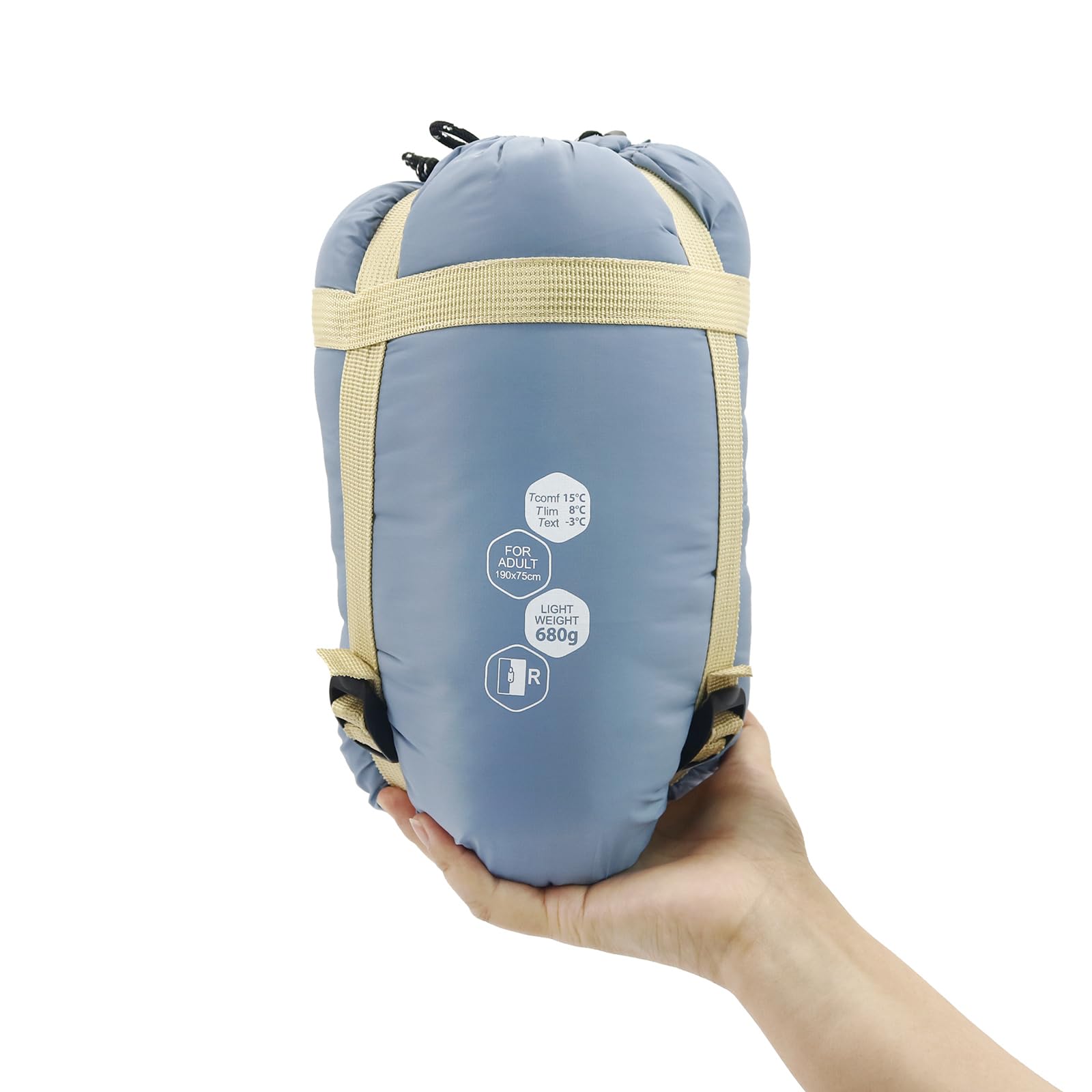
Key Features
- Weight: 1.5 lb
- Packed Size: 11.8 x 6.5 in
- Comfort Temp: 50–70°F
- Insulation: Cotton/synthetic
- Shape: Rectangular
- Price: Budget
NewDoar’s 1.5-lb rectangular bag zips together into a double for fair-weather couples, packing to 11.8 x 6.5 in. The 50-70°F rating and 29.5-inch width set its boundaries: mild nights, average/slim frames, smaller adults and teens. It performs as expected in upper-40s to 50s with a pad, but the comfort ceiling makes it a fair-weather specialist rather than a primary backpacking bag. At this budget price, it suits summer trips where weight and cost outweigh cold-weather margin.
Pros
- Weighs 1.5 lb and packs to 11.8 x 6.5 in, easing the load for budget hikers.
- Soft cotton lining provides a comfortable feel next to the skin.
- Handles upper-40s to 50s nights as a 50-70°F bag should.
Cons
- The 29.5-inch width suits average/slim builds; broader shoulders may find it restrictive.
- Comfort drops off quickly below 50°F, so cold sleepers need layers or a warmer bag.
For smaller adults, teens, and couples on a budget, this is a fair-weather summer bag; outside those conditions, its warmth and cut run short.
How to Choose
The spec that matters most on an ultralight sleeping bag is comfort temperature, not the limit rating printed in the marketing copy.
Weight
Weight is the most reliable spec in this category. Sellers compete hard on ounces, so a bag listed at 1.3 lb will almost always arrive at or near that weight. The real trade-off is what you give up to get there: lighter bags use thinner shells, smaller zippers, and trimmer cuts.
For most backpackers, the practical target is 1.5–2.5 lb. A 1.3-lb down bag saves meaningful pack weight, but a 2.4-lb synthetic bag may be the better choice if you camp in damp conditions and need something you can machine-wash without worrying about down clumping.
Packed Size
Compressed volume is what actually matters in a backpack. Down bags compress far smaller than synthetic bags of the same warmth because down fibers collapse under pressure and rebound when lofted. A 650-fill down bag at 1.3 lb can compress to roughly the size of a water bottle.
Synthetic insulation does not compress as well and loses loft over time from repeated compression. If you pack your bag into a tiny stuff sack for months of storage, synthetic insulation will pack out faster. Down bags should be stored loose or in a large cotton sack, then compressed only for the trip.
Comfort Temperature
Temperature ratings are the least trustworthy spec in this category. A bag labeled with a 32°F limit is often only comfortable at 50°F for an average sleeper. The limit rating assumes you are wearing insulating layers, using a pad with good R-value, and are not a cold sleeper.
Use the comfort rating as your planning number, then subtract 10–15°F if you tend to sleep cold. If the tag says 52°F comfort, expect it to work for most people around 50°F in a tent with a decent pad. Below that, add a liner or wear a puffy jacket rather than trusting the limit number.
Insulation
Down offers the best warmth-to-weight ratio and the smallest packed size, but it loses loft when wet and dries slowly. Synthetic insulation like 3M Thinsulate keeps some warmth when damp, dries faster, and is easier to clean, but it is heavier and bulkier for the same warmth.
For humid climates or trips near water, synthetic is the pragmatic choice. For mountain trails with predictable weather and a focus on pack weight, down is hard to beat. The quality of down matters too: 650-fill is warmer per ounce than 550-fill, and RDS certification confirms the down was sourced responsibly.
Fit and Shape
Mummy bags taper to reduce dead air space, which makes them lighter and warmer for their size, but the narrow cut can feel restrictive for side sleepers and broad-shouldered adults. Envelope and semi-rectangular bags give you room to move but add weight and leave more air to heat.
Before buying, measure your shoulder width and height against the bag’s dimensions. A trim ultralight mummy is a poor fit for a 6-foot, broad-shouldered backpacker, even if the weight looks great. Look for long or wide variants if the standard cut runs snug.
FAQ
Why is my ultralight sleeping bag colder than the temperature rating says?
The printed limit rating is measured with a sleeping pad, base layers, and a warm sleeper, not the average person in a tent. Ultralight bags also have less insulation and a trimmer cut, so cold spots develop faster than in heavier bags. Use the comfort rating as your real-world target and expect to add layers if you sleep cold.
Can I make a 50-degree ultralight sleeping bag warm enough for colder nights?
Yes, with a sleeping bag liner, a puffy jacket, and a high-R-value pad. A liner adds roughly 8–15°F of warmth for a few ounces, and wearing a down or synthetic jacket inside the bag helps more than a second blanket. The real limit is the bag’s shell and zipper drafts; below 40°F, a 50°F bag becomes hard to keep warm no matter what you add.
Do down sleeping bags lose loft if you keep them compressed?
Yes. Down loses insulating power when stored compressed for weeks or months because the clumps never fully re-loft. Store the bag loose or in a large cotton storage sack, and use the compression sack only while traveling. If clumping appears, put the bag in a dryer on low heat with tennis balls to re-break the down clusters.
Down or synthetic ultralight sleeping bag for humid camping?
Synthetic is the safer choice for humid climates, especially if you sleep in a hammock or a poorly ventilated tent. Down absorbs moisture from the air and from your body overnight, losing loft and warmth until it dries. Synthetic insulation like 3M Thinsulate keeps some warmth when damp, dries faster, and can be machine-washed without special care.