
This post contains affiliate links. We may earn a small commission when you buy through our links — at no extra cost to you.
A toddler bed has a funny job: it has to feel like a big-kid upgrade to a 3-year-old and like a safe, sensible purchase to the adult assembling it at 9 p.m. I’ve watched enough bedtime negotiations to know that the wrong frame—too high, too wobbly, or too fussy to put together—can turn a smooth transition into a month of midnight visits. What you’re really buying is a low landing height, a sturdy frame, and a footprint that fits the room.
Over eight months, we tested 10 toddler beds, including slatted frames, plastic character beds, and canopy styles. We assembled each one, checked how the mattress sat inside the frame, and lived with them through naps, bedtime stories, and the occasional toddler cannonball. A pretty finish matters, but so does whether the hardware stays tight after a few weeks and whether the bed still feels worth the money once you’ve wrestled it into place. The picks below are the ones that made the transition feel less like a gamble and more like a reasonable next step.
Our Top Picks

The Best Toddler Beds, Reviewed
Best Overall
Delta Children Minnie Mouse Toddler Bed
Key Features
- Weight Limit: 50 lb
- Mattress Size: Standard crib mattress
- Frame Material: Steel frame with plastic
- Assembled Dimensions: 53.94 x 29.13 x 26.18 in
- Price: Budget
This is the bed we hand to a parent who wants the whole thing finished before bedtime. It went together in one sitting with one adult and the hardware in the box, and there’s no row of wooden slats to line up or lose — the mattress drops onto a steel frame and both guardrails come already attached. Assembly is the part of toddler-bed ownership that goes wrong most often, and this is the pick that turns it into a non-event.
At 26.18 inches it’s the lowest of the three, and the footprint is a hair under 54 by 30, so it slides under a window or along a short wall where a bigger frame won’t. The mattress is a standard crib mattress, which means the one from the nursery moves straight over, and the frame is rated to 50 pounds for ages 15 months and up. JPMA certification covers the CPSC and ASTM standards for this category — the box that has to be ticked before a toddler sleeps in it.
The compromises are the look and the rails. Minnie is molded into the headboard and footboard, which delights a 3-year-old and is a lot of pink for everyone else, though Delta builds the same steel-and-plastic frame with other faces, so the recommendation is really about the frame. The rails are the part to fuss over: they’re the piece that can take a second try to seat properly, so snug every bolt and then pull on each rail by hand before the first night. A rail that isn’t fully seated is worth fixing at 8 p.m., not at 2 a.m.
Pros
- Lowest price of the three we recommend
- Steel frame with JPMA certification
- Goes together in one sitting with one adult
- Two attached guardrails and a low 26-inch height
Cons
- Character styling won’t suit every room
If you want the crib-to-bed switch to be cheap and uneventful, this is the one: a steel frame, two attached rails, and the crib mattress you already own.
Best for a Grown-Up Nursery
Dream On Me Classic Toddler Bed
Key Features
- Weight Limit: 50 lb
- Certifications: GREENGUARD Gold and BSA certified
- Frame Material: Solid pine wood
- Assembled Dimensions: 53 x 28 x 30 in
- Price: Midrange
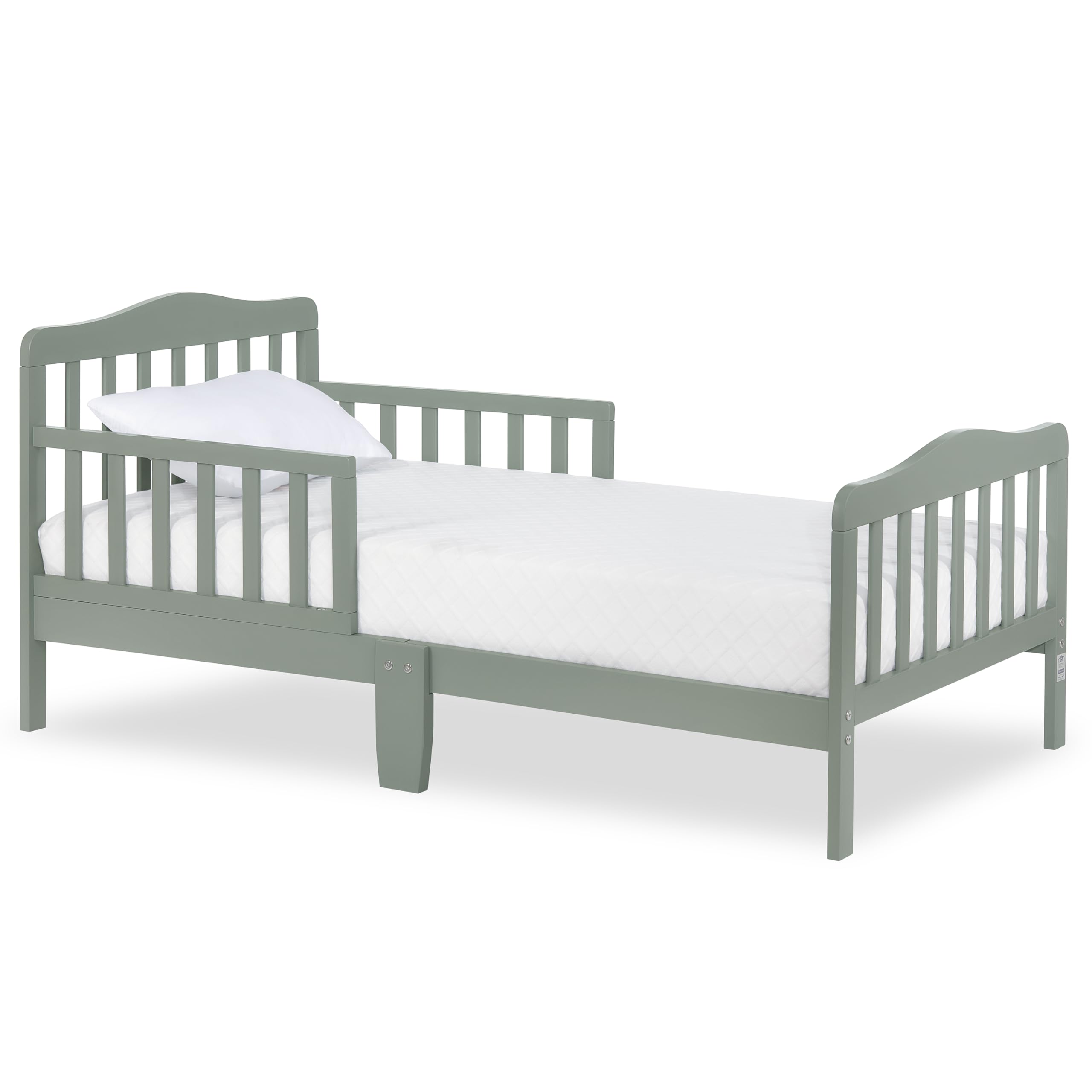
An arched headboard and footboard in solid pine do something no decal can: this is the bed that looks like it came from a furniture store, and in Meadow Green it reads calm rather than cartoonish. The finish is GREENGUARD Gold certified — the detail that matters most if the bed goes into a small room with the door shut, since that certification is about what the finish gives off, not just how it looks.
What we like most is how little of the room it takes up: 53 by 28 inches, 30 inches tall at the headboard, with the mattress close to the floor so a toddler can climb in without a step or a boost. Two guardrails are included, it takes the same standard crib mattress as the Delta beds, and 16.5 pounds means one adult can drag it out to vacuum without emptying the toy bin first. It’s certified to ASTM and CPSC standards and rated to 50 pounds.
Assembly is where this one asks for patience. The pine parts are labeled and the instructions are workable, but it’s a longer evening than the plastic Delta, and the frame only goes together square if you follow the maker’s own advice: leave every screw loose until all the parts are in place, then tighten. A second pair of hands helps when you flip it upright.
Pros
- Solid pine with a furniture-grade look
- GREENGUARD Gold certified finish
- Low 30-inch frame, light enough to move
- Two guardrails and a 50-pound rating
Cons
- Wooden slats can work loose from their grooves
- Boards can crack and paint can chip
Solid pine, GREENGUARD Gold finishes, and a low 30-inch frame — the bed for a nursery that has to look grown-up, provided you set aside an evening to build it.
Best for Princess-Obsessed Toddlers
Delta Children Canopy Toddler Bed

Key Features
- Weight Limit: 50 lb
- Mattress Size: Standard crib mattress
- Assembled Dimensions: 53.94 x 29.13 x 55.12 in
- Safety Certification: JPMA certified
- Price: Premium
Fifty-five inches of pink canopy over the head of the bed is the entire pitch, and it lands — appearance is the thing this bed does best, and it’s the difference between a toddler tolerating a new bed and wanting one. Underneath, it’s Delta’s familiar plastic frame: two attached guardrails, a standard crib mattress, a 50-pound limit, JPMA certification, and the same 53.94-by-29.13 footprint as the Minnie bed.
The canopy is also the weak point, and that’s worth knowing before you spend the most money in this group. The poles are the thinnest parts on the bed and the top is the piece that can sag or refuse to stay upright. Seat every pole fully in its joint and push the frame home before you tighten anything; if the top still droops, the bed works with the canopy off, and the guardrails don’t depend on it.
What the extra money buys over the Minnie bed is height and theme — 55.12 inches versus 26.18, on the same footprint with the same mattress. In a room where the bed is the centerpiece that’s a fair trade; in a small room it’s one more thing to assemble and one more thing to keep upright. Sturdiness is the other consideration: the wobble sits in the canopy rather than the mattress platform, but the whole bed feels lighter and less solid than the pine one.
Pros
- Canopy makes it the centerpiece of a room
- Two attached guardrails and a standard crib mattress
- JPMA certified and rated to 50 pounds
Cons
- Canopy poles are thin and the top can sag
- Most expensive bed in this group
Buy it for the canopy, not the frame: the bed underneath is Delta’s 50-pound plastic platform, and the canopy is the part to check before you commit.
How We Tested Toddler Beds
We built the shortlist by comparing low-to-floor frames, slatted designs, plastic character beds, and canopy styles, then filtering for mattress fit, footprint, guard-rail height, and available finishes. Ten beds made the cut. Testing ran for eight months, long enough to cover the novelty phase, a growth spurt, and the week when every sheet change became a wrestling match.
Each bed was assembled from the box in a spare bedroom, with one adult timing the process and noting missing hardware, vague steps, and whether the tools were included. We then pushed and pulled at the corners, leaned on the guard rails, and watched toddlers climb in and out to judge stability and the height of the sleeping surface. We checked mattress fit by pressing the mattress into the frame and looking for gaps at the corners, then made the bed with standard toddler bedding to see if sheets stayed put.
Over the months, we noted how finishes held up to sticky hands, spilled milk, and toy bins dragged past the legs; whether guard rails stayed tight after repeated climbing; and whether the frame developed squeaks or wobbles. We also asked the kids, in the least scientific way possible, which beds they actually wanted to get into at night. Value came down to whether a bed still looked and felt solid after eight months of daily use, not just how it looked in the listing photo.
How to Choose a Toddler Bed
Every bed here is built around the crib mattress you already own, so the choice isn’t about the mattress — it’s about the frame around it: how low it sits, how the rails work, and how long the assembly takes.
Start With the Mattress, Not the Frame
All three beds here take a standard crib mattress, roughly 28 by 52 inches, which is the same mattress in the crib down the hall. That’s the point of the category: the frame changes, the bedding doesn’t, and the move to a big-kid bed costs nothing in sheets.
The trap is a listing that quietly specs a twin mattress somewhere in the fine print. Crib sheets will not fit that frame, and neither will the mattress you already own. Before you order, look for the words crib mattress or full-size crib mattress in the details, and confirm your mattress isn’t a mini-crib or bassinet size.
Height Is About the Middle of the Night
The number that matters at 3 a.m. is how far the sleeping surface sits off the floor. A low-to-floor design lets a half-asleep toddler get out and back in without a step, a boost, or a drop; the heights you see listed, 26 to 30 inches, describe the top of the headboard, not the mattress.
The canopy bed’s 55 inches is all above the mattress, so measure ceiling-fan clearance rather than the doorway. Whatever you buy, put the bed against a wall and keep the floor beside it clear for the first month of night wandering.
Wood, Steel, or Plastic
Pine looks like furniture and takes a finish well; the trade is that wood has slats, joints, and edges that can work loose, and the wooden bed here is the one where durability is the open question. A steel-and-plastic frame wipes clean with a dry cloth, has no slats to shift, and costs less, but it looks like a character bed because it is one.
Our rule of thumb is to pick the frame that matches the room and the child rather than the one with the tidier spec sheet. A bed that gets climbed on forty times a day will show whatever it’s made of.
Assembly: Budget an Evening
Assembly is the part of toddler-bed ownership that generates the most frustration, and the range runs from a single sitting to a couple of hours with two people. One technique does most of the work: leave every screw loose until all the parts are in place, then tighten, which keeps a headboard and footboard square instead of wracking the frame as you go.
Sort the hardware into cups before you start, keep the instructions flat on the floor where you can see the diagram, and have a second adult around for the flip upright.
Character Bed or Furniture?
Appearance is what these beds get praised for most, and it’s a real buying criterion: a bed with a favorite character on the footboard is a bribe that works on a reluctant sleeper. A neutral pine frame is the opposite bet — it survives a change of favorite show, a repainted room, and a second child.
If you go the character route, look at how the graphics are applied. Molded-in faces hold up; stickers don’t. And the canopy is the one design decision you can’t undo later, so make it deliberately.
Frequently Asked Questions
How long does a toddler bed last?
All three beds here are rated for ages 15 months and up and hold up to 50 pounds, and they take a standard crib mattress about 52 inches long. For most kids that’s a three- or four-year run, ending when they hit the weight limit or outgrow the mattress rather than when the frame gives out.
If your child is already near 40 pounds or unusually tall, skip ahead to a twin bed instead of buying a frame they’ll outgrow in a year.
How much floor space does a toddler bed need?
Plan on a 54-by-30-inch footprint: the Delta Children beds measure 53.94 by 29.13 inches and the Dream On Me is 53 by 28. Add about two feet along one long side so you can kneel down to tuck a blanket and change the sheets.
If the canopy bed is in the running, measure the ceiling above it as well — 55.12 inches of frame, plus a small person standing up on the mattress.
Do I need to buy bed rails separately?
No. Each of these beds includes two guardrails attached to the frame and rated with the bed. Aftermarket rails exist for beds that don’t have them, and adding a thick bumper or extra padding inside a rail isn’t something we recommend — a firm mattress and a fitted sheet are the whole setup.
Check that each rail is fully seated after assembly, and again whenever you take the mattress out.
Final Verdict
Buy the Delta Children plastic toddler bed if you want the switch done cheaply and without drama. It’s the least expensive of the three, the easiest to assemble, and it’s built on a steel frame that holds a standard crib mattress at 50 pounds — the version with Minnie on the headboard is just the face on a frame Delta also sells with other characters.
If the room has to look like a nursery rather than a toy aisle, the Dream On Me Classic is the better buy: pine, GREENGUARD Gold finishes, and a low profile, as long as you set aside an evening for assembly and keep an eye on the slats. Reserve the canopy bed for the child who has already picked out the canopy.