
This post contains affiliate links. We may earn a small commission when you buy through our links — at no extra cost to you.
Most sleep apnea pillow listings promise the same thing: memory foam, universal mask compatibility, and a better night’s sleep. The first night often tells a different story — foam that feels harder than expected, a wedge that slides during the night, or a CPAP pillow that still leaks around a full-face mask.
The deciding factor is how well the pillow matches the way you actually sleep. Side sleepers need a soft transition at the edge, back sleepers need stable torso elevation, and CPAP users need mask clearance without losing neck support.
That means choosing between a plush, contoured surface and a firm, stable incline. The right call depends on your sleeping position, your CPAP mask, and whether you need daytime reading support or overnight reflux relief.


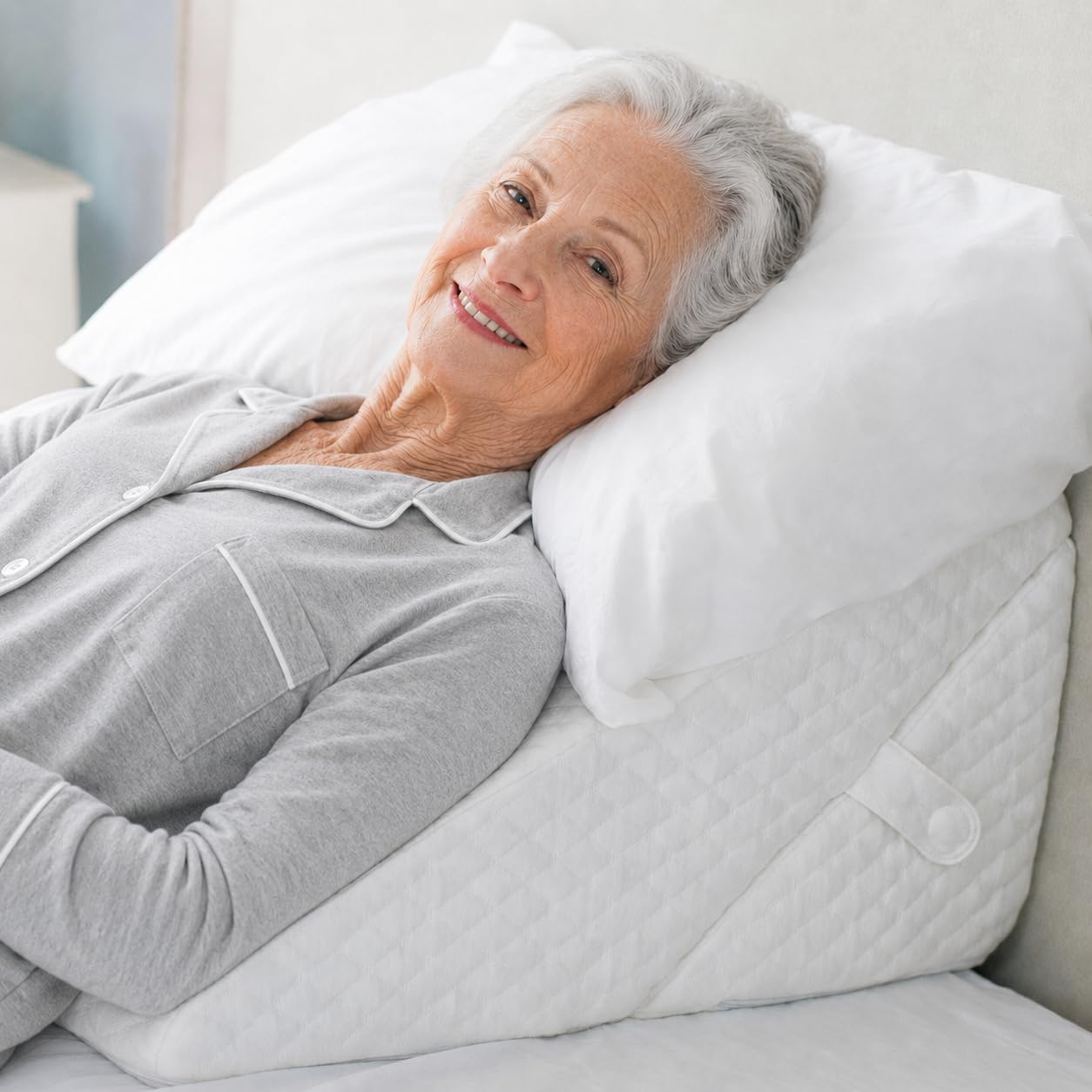

Best for Back Sleepers
Kölbs 7.5" Bed Wedge
Key Features
- Elevation Height: 7.5-inch wedge
- Comfort Layer: 1.5-inch memory foam
- CPAP Fit: No mask cutouts
- Adjustability: Fixed wedge
- Cover Care: Washable Jacquard cover
- Price: Budget
The 7.5-inch full-torso incline keeps sleep apnea and reflux symptoms in check while the 24-inch-wide surface holds back sleepers in position through the night. A removable Jacquard cover washes clean, and the 1.5-inch memory-foam top adds a soft contact layer without changing the slope’s support. The same wedge doubles as a reading or TV prop, which stretches the value beyond sleep. The wide base stays planted on the mattress when you shift to sit up.
The dense core keeps its shape under body weight, so the incline stays consistent for back sleepers who need the same elevation every night. The washable cover matters for reflux users who deal with spills or residue. At 7.5 inches, the height provides practical upper-body elevation without feeling like a hospital bed, and the 24-inch surface gives enough room to move without slipping off.
Best for back sleepers managing sleep apnea or reflux who want full-torso elevation without paying a premium. Side sleepers who are sensitive to firm foam should plan for a thicker comfort layer or look to the softer memory-foam wedge in this lineup. CPAP users who need mask cutouts are better served by a contour pillow.
Pros
- Full-torso 7.5-inch elevation provides a stable slope for sleep apnea and reflux relief.
- Wide 24-inch surface supports back sleepers and doubles as a reading or TV wedge.
- Removable Jacquard cover and dense core hold up at a budget-friendly price.
Cons
- High-density core may feel hard for side sleepers; an extra comfort layer can soften the surface.
- No CPAP-specific mask cutouts, so CPAP users need to manage their own pillow positioning.
Back sleepers and reflux sufferers who want full-torso elevation without a premium price get a washable wedge that maintains its incline through the night.
Best for Side Sleepers
Sleepnitez 8" Wedge Pillow
Key Features
- Elevation Height: 8-inch wedge
- Comfort Layer: 3.25-inch memory foam
- CPAP Fit: No mask cutouts
- Adjustability: Fixed wedge
- Cover Care: Washable Tencel cover
- Price: Mid-Range
The Sleepnitez wedge layers 3.25 inches of memory foam over a tapered 0.2-inch edge, so the transition from mattress to incline is noticeably softer than standard one-piece wedges. Side sleepers with sleep apnea, snoring, or GERD get support without the hard base pressure at the mattress line. That makes it a practical match for CPAP users who dislike hard wedge surfaces.
This is a sleep-first wedge for side sleepers and CPAP users who want a soft base under their mask without cutouts. Buyers who need a steep 12-inch full-torso wedge or a firm, rigid medical incline should skip it; the surface prioritizes comfort over unyielding support.
Pros
- Soft memory-foam top avoids the hard bump where the wedge meets the mattress.
- Neck and back support suits side sleepers with sleep apnea, snoring, or GERD.
- Noticeably softer surface than typical wedge pillows, easing pressure on hips and shoulders.
Cons
- Bed readers may find the 8-inch height too low and too soft for comfortable sitting.
The Sleepnitez fits side sleepers managing sleep apnea, snoring, or GERD who want a softer wedge without the hard line between mattress and incline.
Best for Cpap Users
Lunderg CPAP Pillow
Key Features
- Elevation Height: 1.1-inch removable layer
- Comfort Layer: Dense memory foam
- CPAP Fit: Contoured mask cutouts
- Adjustability: Removable height layer
- Cover Care: 2 washable cases
- Price: Premium
The nose and cheek recesses give nasal pillow masks room to sit without shifting, and the removable layer tailors height for side or back sleeping. This is a mask-specific contour pillow rather than an incline aid, so it addresses leak and pressure-point issues at the head instead of elevating the whole torso.
This is for CPAP users who wake with mask leaks or neck pain and want a position-specific pillow. Fit still varies by mask style and face shape — a nasal-only mask can sit on an air gap in the cutout — and the 21.65-inch length runs shorter than a standard bed pillow, so restless movers may want extra pillows for coverage.
Pros
- Contoured cutouts keep nasal pillow masks sealed during side sleeping.
- Removable height layer lets you adjust loft for side or back positions.
- Dense memory foam supports head and neck without collapsing in the cutout.
Cons
- Side sleepers with sensitive ears may find the firm memory foam too hard for all-night comfort.
If mask leaks wake you up, the dedicated cutouts and adjustable height give you a reason to move off a flat pillow.
Best for Full-Torso Back Sleepers
Bekweim 12" Wedge Pillow
Key Features
- Elevation Height: 12-inch to 9-inch
- Comfort Layer: Memory foam top
- CPAP Fit: No mask cutouts
- Adjustability: Two height settings
- Cover Care: Washable bamboo cover
- Price: Budget
The Bekweim’s 12-inch incline is its defining feature, and the 9-inch low setting gives it a two-position adjustability that fixed wedges do not have. The supportive foam base and memory-foam top keep back sleepers, CPAP users, and recovery patients at a stable full-torso angle; compared with the top pick’s 7.5-inch elevation, this is the taller option.
This is for back sleepers who need a high, stable full-torso incline for sleep apnea, oxygen therapy, or post-surgery recovery. The 12-inch profile is steep and firm; side sleepers and smaller-framed users will likely find it too aggressive.
Pros
- Full-torso elevation holds firm for CPAP, oxygen therapy, and recovery sleep.
- Adjustable 12-inch and 9-inch positions suit different incline needs.
- Strong support for sitting up and sleeping elevated, with a stable wedge base.
Cons
- The 24-inch footprint takes up noticeable bed space, especially on smaller mattresses.
Back sleepers who want a high, stable incline for apnea or recovery will find the 12-inch platform delivers.
Best for Post-Surgery Recovery
Hansleep 6-Piece Wedge Set
Key Features
- Elevation Height: Multiple positioning heights
- Comfort Layer: Memory foam pieces
- CPAP Fit: No mask cutouts
- Adjustability: 6-piece modular system
- Cover Care: Zippered washable covers
- Price: Mid-Range
Head, back, lumbar, and leg pieces combine into several useful configurations for sleep apnea and recovery positioning. The modular setup stands apart from single-piece wedge pillows because the Velcro connections let the incline shift between upright reading, sleep, and leg elevation. The set also supports an upright sleeping position, which makes it more adaptable than a fixed wedge.
This suits sleep-apnea users who also need post-surgery support or lumbar relief, along with caregivers who want to reposition a patient without buying separate pillows. Buyers who want a single, simple sleep-apnea wedge should choose a one-piece option instead. The bulky footprint and significant bed space mean it is less practical for small beds or tight storage.
Pros
- Comfortable for recovery and reading, with no skin irritation from the covers.
- Large, well-constructed pieces stay stable through repeated repositioning.
- Supports abdominal recovery and lumbar pain while keeping an elevated sleep angle.
Cons
- On softer mattresses, the high-density base pieces can feel stiff despite the memory-foam label.
For sleep-apnea users who need adjustable recovery positioning, this modular set covers more ground than a fixed wedge; anyone looking for one simple incline will find the extra pieces unnecessary.
Best for Budget Wedge Set
MEGCXIT 3-Piece Wedge Set

Key Features
- Elevation Height: Multiple modular heights
- Comfort Layer: Gel memory foam
- CPAP Fit: No mask cutouts
- Adjustability: 3-piece modular system
- Cover Care: Washable knitted cover
- Price: Budget
This modular set offers multiple configurations for sleep apnea, reflux, or reading, with a gel memory foam headrest and machine-washable cover at a budget price. Firm foam and Velcro edges can irritate bare arms, and pieces may shift overnight, keeping it behind a stronger modular option for side sleepers. It suits back sleepers who want an adjustable setup.
Pros
- Three-piece design adjusts to multiple heights and angles for sleep apnea or reading.
- Budget-friendly price makes this a low-commitment way to test elevated sleeping positions.
Cons
- Firm foam and side Velcro edges can irritate bare arms; pieces may shift during sleep.
Best for budget-focused back sleepers who want multiple wedge angles and can tolerate firmer foam; side sleepers with sensitive arms will want a softer or seamless option.
How to Choose
The height, firmness, and edge of a sleep apnea pillow matter more than the ‘memory foam’ label on the box.
Elevation Height
Higher wedges raise your upper body further, which helps keep your airway open, but they also shift more weight onto your hips and lower back. A 12-inch wedge creates a steeper angle than a 7.5-inch wedge, so smaller-framed sleepers can feel pushed toward the foot of the bed.
Back sleepers who need full-torso elevation for severe reflux or post-surgery recovery benefit from the taller profile; side sleepers usually handle a gentler incline better.
Comfort Layer
Most wedge pillows use a firm support core because it holds the incline; the memory foam layer is only what your body touches. A 1-inch layer softens pressure slightly, while a 3.25-inch layer can make the difference between sleeping on a hard ramp and sleeping on a padded slope.
Edge taper matters for a different reason: a thin edge where the wedge meets the mattress eases the transition, so you don’t feel a ledge under your shoulder.
CPAP Fit
Contoured CPAP pillows remove foam where the mask touches, which reduces pressure on the mask frame and helps keep the seal intact. The trade-off is fit variability: cutouts sized for a nasal-pillow mask may not line up with a full-face mask or a particular face shape.
If you wake with mask leaks, a contour pillow is worth trying, but expect some trial with your specific mask and sleeping position.
Adjustability
Adjustable wedge sets use removable layers or multi-piece sections to change height and angle after taking the pillow home. That flexibility helps if your needs change during recovery or if you use the same setup for reading and sleeping.
The trade-off is bulk and stability: more pieces mean more bed space, and side-mounted connections can get in the way if you sleep near the edge.
Cover Care
A washable cover matters because wedges collect sweat, drool, and skin oil over years of nightly use. Zippered covers are easier to remove and replace than slip-on covers, and memory foam should never go into a washing machine.
Look for a machine-washable cover that can be dried flat so you don’t end up hand-cleaning a 24-inch wedge.
FAQ
Why does my sleep apnea wedge pillow feel so hard even though it’s labeled memory foam?
Wedge pillows use a firm support core to hold the incline; the memory foam layer is just the comfort surface. If the foam layer is only 1 inch thick, you’ll still feel the hard core underneath. Look for a wedge with at least 2 to 3 inches of memory foam or a contoured CPAP pillow for a softer feel.
Do CPAP pillows work with full-face masks or only nasal masks?
CPAP contour pillows reduce leaks for many full-face mask users, but fit depends on mask shape and face length. Cutouts positioned for a nasal-pillow mask may not align with a larger full-face mask. If you use a full-face mask, check the pillow’s dimensions and look for user reports with your mask type.
How do I stop sliding down my bed wedge pillow at night?
A slippery mattress, steep angle, and smooth pillow cover all contribute. A wedge with a textured or non-slip base and a removable cotton-like cover helps, as does placing the wedge directly against the headboard. If you still slide, a 7.5-inch incline instead of a 12-inch one reduces the slope while keeping enough elevation for airway support.
Should I buy a CPAP contour pillow or a wedge pillow for sleep apnea?
For most apnea and reflux needs, a wedge pillow is the more versatile choice because it provides upper-body elevation and works with any CPAP mask. Choose a CPAP contour pillow only if your primary problem is mask leaks or neck pressure while side sleeping. If you need both elevation and mask relief, prioritize the symptom that wakes you more often.