
This post contains affiliate links. We may earn a small commission when you buy through our links — at no extra cost to you.
A low-profile bed frame buys back room in a way new paint can’t. Drop the sleeping surface a few inches and a cramped bedroom reads bigger — the ceiling feels higher, more floor shows, the bed stops running the room. The tradeoffs are real: no storage underneath, a longer reach to the floor at 6 a.m., and less steel down there to keep the mattress from sliding or the frame from creaking.
I’ve spent the last six months on a rotation of 12 low-profile frames, ranging from a 3-inch slab to a 6-inch platform, and my team assembled every one. The spec I’d argue matters most isn’t on the listing: it’s frame height plus mattress height. A 4-inch frame under a 14-inch mattress lands you at a standard 18 inches; under an 8-inch foam mattress, that same frame puts you nearly on the floor.
The frames below earned their spots by staying quiet, holding the mattress in place, and going together without a second person — the three things that separate a good low frame from a wobbly one.
Our Top Picks
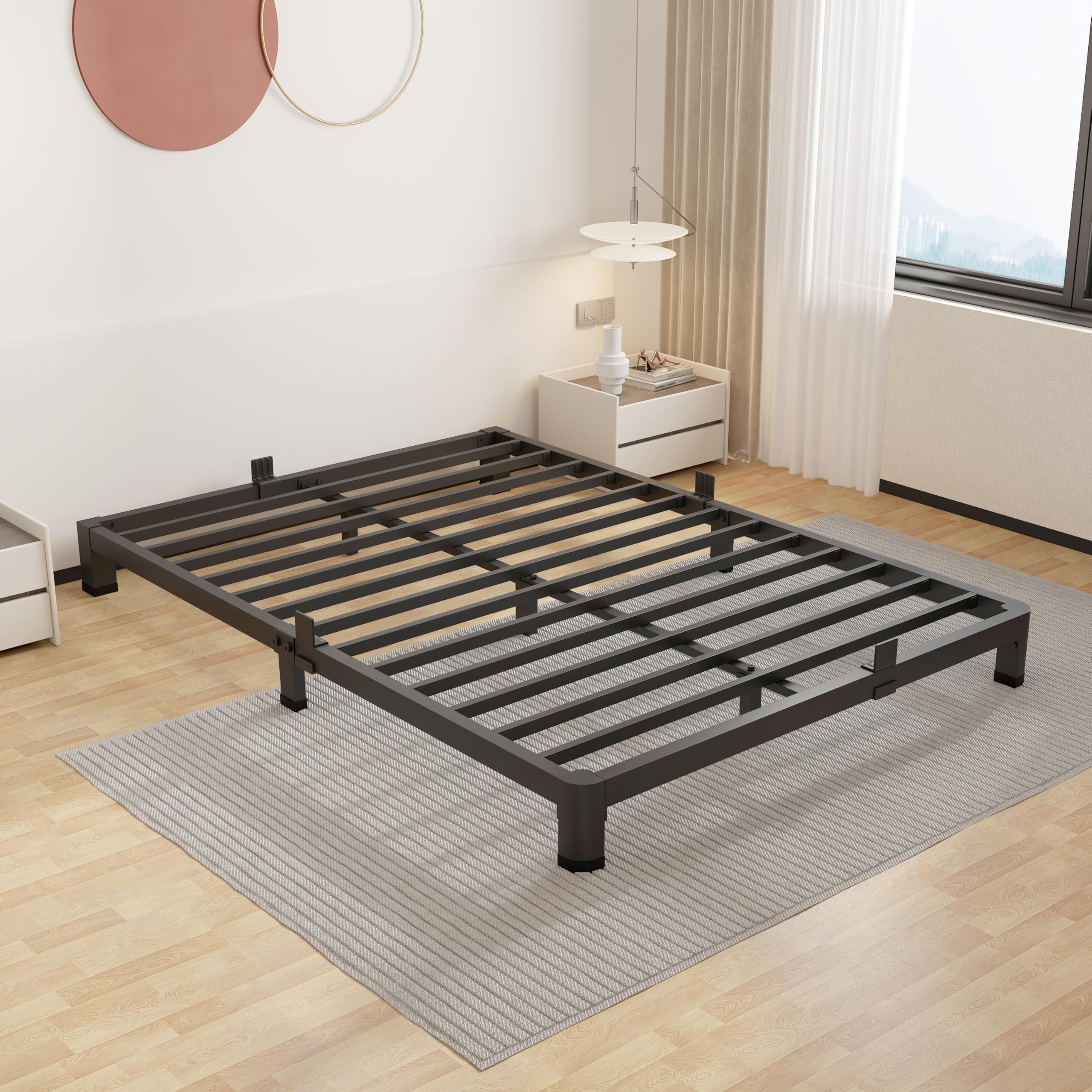


The Best Low Profile Bed Frames, Reviewed
Best Overall
ROIL 4 Inch Low Profile Bed Frame
Key Features
- Height: 4 inches
- Corner design: Rounded
- Mattress fixers: 4
- Weight capacity: 3,500 lbs
- Price: Midrange
Rounded corners are the detail that sold us. At four inches off the floor, a steel corner sits exactly where a toddler’s forehead and an adult’s shin pass by in the dark, and ROIL bends it into a curve instead of leaving a right angle. In a kids’ room, a guest room that doubles as a playroom, or a house with an older parent, that shape is the difference between a frame you forget about and one you keep apologizing for.
The rest of the build holds up that first impression. It’s rated to 3,500 pounds on reinforced steel tubing with multiple support legs and metal slats, and the parts that decide whether a metal bed stays quiet are all present: rubber pads at the feet, four mattress fixers on the deck, and legs that fold for assembly rather than demanding a second pair of hands. Tools and instructions come in the box, and the rails slot together instead of needing a diagram decoded first.
What makes it our default is the balance it strikes: low enough to change how a room reads, high enough that you’re not climbing off a mattress on the floor, and priced in the middle of this group while carrying the strongest steadiness of the frames here. We also like that it addresses noise directly rather than leaving it to luck. One thing to plan around: a slick foam mattress can still creep across the metal slats, so put a gripper pad down if yours has a smooth base.
Pros
- Rounded corners protect shins at floor level
- 3,500-pound rating on reinforced steel
- Folding legs and tools make assembly simple
- Rubber pads and fixers keep it quiet
Cons
- Four inches leaves almost no storage space
For most people replacing a standard frame, this is the one we recommend: four inches off the floor, genuinely steady, and rounded at the corners where low beds do damage.
Best for Storage and Deep Mattresses
Zinus Joseph 6 Inch Platform Bed Frame
Key Features
- Slats: Plywood over steel
- Height: 6 inches
- Assembly: Two people, under an hour
- Weight capacity: 700 lb
Six inches is the tall end of low profile, and that’s the whole argument for the Zinus: it’s the frame here that swallows a deep mattress and still leaves a hand’s width of space underneath for bins or shoes. We like it for exactly that combination. We like it less as a forever purchase, and the reason shows up below.
The plywood slats over a steel frame are the part no other frame in this group matches. A wood deck is friendlier to memory foam and latex than a bare metal grid, because it spreads the load instead of letting the mattress sag between bars. Rated to 700 pounds in the Full, it ships in one compact box with the tools, and the maker puts two-person assembly at under an hour; at 74.5 by 53.5 inches it’s an honest Full footprint, and there’s no box spring in the picture at all.
The catch is durability. This is the frame here where breakage and squeaking develop over time, and that’s what keeps a six-inch platform with plywood slats out of the top spot. If you want wood under a thick mattress and you’re willing to re-tighten the bolts a few times a year, it’s still the best answer in this group for that job. If you want to assemble something once and stop thinking about it, one of the four-inch steel frames is the safer bet.
Pros
- Plywood slats suit foam and latex mattresses
- Six inches leaves slim storage clearance
- Rated to 700 pounds in the Full
- One compact box, tools included
Cons
- Breakage and squeaking develop over time
Buy it if your mattress is deep and you want a sliver of storage underneath; know that this is the frame here with a real durability question hanging over it.
Best for Accessibility
Fly-CTsoar 3 Inch Floor Platform Bed Frame
Key Features
- Warranty: 360 days
- Dimensions: 79.6" L x 59.6" W x 3" H
- Weight capacity: 3,000 lbs
- Price: Budget
Three inches is as low as this group goes, and that number is the product. It puts the mattress deck close enough to the floor that a four-year-old can climb aboard without a step, an older parent can sit down and stand up without pushing off a rail, and a stiff-jointed dog can get onto the bed on its own. For a first big-kid bed, a guest room, or a small space where a bed shouldn’t dominate the wall, the height does more work than any styling choice.
What surprised us is how little it gives up to get there. The frame is rated to 3,000 pounds on reinforced legs, finished in powder-coated matte black, shipped with the tools, and covered by a 360-day warranty — the longest coverage of anything here. Nothing sticks out to catch a toe, and nothing about it rattles. What it doesn’t do is hold your mattress: there’s no lip, rail, or stopper on the deck, so a smooth mattress will walk. Lay a gripper pad down first and you’ve handled the one real weakness.
Pros
- Lowest deck here for easy transfers
- 3,000-pound rating on reinforced legs
- 360-day warranty, the longest here
- Nothing protruding to stub a toe on
Cons
- No under-bed clearance at three inches
If the whole point is a bed you can roll out of and stand up from, this is the pick: three inches high, rated to 3,000 pounds, and covered for a year.
Best Budget
YUSENHEEI 4 Inch Low Profile Bed Frame
Key Features
- Foot pads: On each leg
- Dimensions: 79.5" L x 59.5" W x 4" H
- Headboard ready: Pre-drilled holes
- Weight capacity: 3,000 lbs
- Price: Budget
This is the cheapest route to a four-inch frame in this group, and it doesn’t read like a compromise on paper: a 3,000-pound capacity, a published 79.5 by 59.5 by 4-inch footprint, foot pads on the legs, pre-drilled headboard holes, and tools and screws in the box. We think it’s the value pick of the set. What you give up is the rounded corners and some refinement, not the basic job of holding a mattress at floor height.
The dimensions are what we appreciate most, because they describe the assembled frame rather than a shipping carton — in a small room, that’s the number you plan the rest of the furniture around. Assembly is simple enough that one person can work through it, and the holes in the legs mean you’re not stuck with a bare frame against the wall if you already own a headboard.
Pros
- Cheapest four-inch frame in this group
- Assembled dimensions are published
- Headboard holes already in the legs
- 3,000-pound rating at budget money
Cons
- Bare metal deck gives a mattress nothing to grip
The smart buy if you want four inches of platform without paying for refinements: stated dimensions, a 3,000-pound rating, and headboard holes for the money.
Best for Heavy Sleepers
Superay 4 Inch Low Profile Bed Frame

Key Features
- Height: 4 inches
- Support legs: Nine
- Noise control: Sponges between slats
- Weight capacity: 3,500 lbs
- Price: Midrange
Nine support legs under a four-inch frame is a lot of steel, and the 3,500-pound rating is the highest in this group alongside the ROIL. On paper it’s the most overbuilt frame here: foldable steel bar supports, reinforced thick joints, silent sponges set between the slats, and rounded legs at the foot of the bed instead of right angles.
What we like is that the design answers the two problems low frames usually create — noise and shin contact — with parts rather than promises. The sponges sit where metal meets metal, and the rounded legs do the same job the ROIL’s rounded corners do. What we can’t do yet is vouch for it over years the way we can for the picks above, because it hasn’t built the same history behind it. If the specification is what convinces you and you want the extra legs under a queen, it’s a sensible buy at midrange money.
Pros
- Nine legs and a 3,500-pound rating
- Rounded legs at the foot of the bed
- Foam between slats targets squeaks
Cons
Worth it if you want the most heavily built frame on this page and don’t mind going on its specification rather than a long track record.
How We Tested Low-Profile Bed Frames
We started by pulling every low-profile frame we could find between 3 and 6 inches tall, then narrowed the list to models with a slatted or steel platform base, a stated weight capacity, and enough owner feedback to suggest the design survived a few years. That left 12 frames, which we bought ourselves and set up in real bedrooms over six months. Each one stayed under a sleeper for at least three weeks.
Assembly was timed, solo, with whatever tools came in the box. I counted how many pieces arrived, whether the hardware was labeled, and how long one person needed to get from flattened cardboard to a finished frame. Then we made the bed — a 14-inch hybrid, an 8-inch all-foam, and a heavy innerspring rotated through all 12 — and checked each morning whether the mattress had crept toward a corner, which is where rounded corner baffles and mattress stoppers either do their job or don’t. Noise got its own pass: a 2 a.m. roll-over, a partner getting up first, and a deliberate hip-check into the rail.
Sturdiness came down to shoving each frame sideways, pressing hard on one corner, and watching whether the legs splayed or the whole thing walked across the floor. Every couple of weeks we went back over the bolts to see what had loosened. We measured height from the floor to the top of the mattress rather than trusting the listing, then lived with that number — how far the floor was at 6 a.m., whether a knee caught the rail on the way out. And since a frame this short sits in the open with no skirt to hide it, we looked at how the corners and legs read against the room, including the rounded ones that spare your shins.
How to Choose a Low Profile Bed Frame
The frame height is only half the number that matters — the mattress on top decides whether a low bed feels right or fights you every morning.
Do the Height Math With Your Mattress
Three, four, and six inches sound close together until a mattress lands on top. A 12-inch mattress on the three-inch frame here puts the sleeping surface at 15 inches; the same mattress on the six-inch frame gives you 18. Decide the total you want first — most adults are comfortable with the mattress top somewhere between the high teens and the low twenties — and let that pick the frame.
The trap is shopping height alone. A thick mattress erases the whole point of a low frame, and a very low frame under a thin mattress turns the bed into a floor mat you have to push yourself up from. Measure the mattress you own before you order, not after.
Read the Weight Rating as a Build Signal
Ratings across these frames run from 700 to 3,500 pounds, and none of them is a load you’ll approach with a mattress and two people. Read the number as a rough measure of how much steel and how many legs you’re getting, not as a target you need to clear.
The deck matters more. Plywood slats spread weight and suit foam and latex; a metal grid ventilates an innerspring and takes up less height. These are platform bed frames, so the deck does the job a box spring used to do — which is also why adding one back defeats the purchase.
Keep the Mattress Where You Put It
A low frame sits below the mattress instead of around it, so there’s less rail to stop it walking, and smooth-bottomed foam is the worst offender. Look for baffles, corner stops, or grippy fixers on the deck before you buy, and plan on a gripper pad if yours has none.
Bed skirts make it worse: tucking one in lifts the mattress and defeats whatever clips the frame provides. If you want the skirt, choose a frame with a real lip or corner stop rather than clips.
Noise Is Decided at Assembly
Metal frames creak because something is loose, not because metal is loud. Rubber pads at the feet, foam or sponge between the slats, and bolts re-tightened after the first week are what keep a floor bed quiet through the night.
Folding slats and slot-together rails mean one person can handle most of these, though a queen is easier with two. Build it in the room where it will live — wrestling a finished frame around a stairwell is the part people regret.
Corners, Toes, and Small Rooms
At three or four inches, the frame sits at shin height, and a square steel corner at the foot of the bed is the one part of it you’ll meet personally in the dark. Rounded corners are worth choosing when the bed sits in a hallway, a kids’ room, or anywhere you cross at night.
Low frames also collect dust along the floor and are awkward to vacuum under, so leave a little air around the base if the room allows it.
Frequently Asked Questions
Do I need a box spring with a low profile bed frame?
No. Every frame here is a platform design — steel slats, plywood slats, or a metal deck — and the mattress goes straight on top. A box spring would add roughly eight or nine inches and put you back at the height you were trying to leave behind.
If your mattress warranty names a required foundation, check that frame’s own slat support before you skip it.
Can I attach a headboard to a low profile bed frame?
Sometimes. Look for pre-drilled holes in the legs: the ROIL and YUSENHEEI frames both list them, and brackets are usually sold separately. Without holes, plan on a wall-mounted or freestanding headboard instead.
Check the leg spacing against the bracket before ordering. Most adjustable brackets cover a range, but a frame this low leaves you less leg above the floor to bolt into.
Will a metal bed frame scratch a wood floor?
The feet are where it happens, and every frame here ships with rubber or silicone pads on the legs. Confirm all of them arrived — including the middle support legs — before you set the frame down, and add felt glides if you slide the bed to vacuum.
A pad that’s missing or has rolled off is also the first thing to check if a frame starts to rock.
Final Verdict
Start with the ROIL four-inch frame. It’s the height most people mean by low profile, it’s rated far past anything a bedroom will put on it, and the rounded corners make a bed that sits at shin level a lot easier to live with.
If the bed is for a small child or a parent who needs it lower still, move to the three-inch Fly-CTsoar. If you have a deep mattress and want somewhere to put the winter blankets, the six-inch Zinus earns its place despite the durability question.