
This post contains affiliate links. We may earn a small commission when you buy through our links — at no extra cost to you.
Kids bed listings lean heavily on licensed characters and canopy drama, but the practical purchase decision comes down to certification, height, and mattress fit. A themed bed only works if the frame stays safe and the theme doesn’t become a chore after a few months.
The trade-off is character wow-factor versus long-term durability. Canopies, decals, and 3D accents create the excitement, and those are exactly the parts that wear out first. Low, certified wood frames tend to keep their function longer, which is why the strongest choices balance a clean look with structural priorities.
Start with the mattress you already own. Most toddler beds accept a standard crib mattress, so the first step is often a low frame that reuses it; moving to twin is a separate decision for a later age.



Best for Crib-To-Bed Transition
Delta Canton Toddler Bed
Key Features
- Safety & Rails: JPMA; 2 guardrails
- Mattress Size: Full-size crib mattress
- Profile Height: 24.5-in tall
- Material & Finish: Solid wood; GREENGUARD
- Price: Budget
The Canton is a GREENGUARD Gold-certified solid-wood toddler bed with attached guardrails and a grey finish that fits real rooms without committing to a character theme. It sits low enough to reduce fall distance, uses a full-size crib mattress, and reads as actual furniture rather than a plastic stopgap. The frame feels solid for the budget price, the neutral grey works with existing nursery pieces, and the dimensions are scaled for a child’s room rather than a standard adult bed. The wooden build also gives it more presence than similarly priced plastic frames. For families moving from crib to floor-height sleeping, the attached guardrails remove the extra rail-fitting step and keep the setup simple.
This suits parents who want a safe, neutral first bed and are comfortable with a DIY assembly project. The frame arrives unassembled, so give the hardware bag a quick sort before starting; checking screw lengths beforehand avoids a mid-build stop. Kids who need a character theme to get excited about sleep will respond better to a themed option, but for a room that just needs a low, certified wood bed, the Canton is the practical call. It doesn’t advertise ‘toddler furniture’ from across the room, and that neutrality is exactly what helps the bed blend into everyday bedrooms.
Pros
- Solid wood with attached guardrails keeps the bed stable as a first big-kid bed.
- Neutral grey finish fits real rooms and avoids the licensed-character look.
- Full-size crib mattress fits, so the transition doesn’t require a new mattress.
Cons
- Screw quality can vary between units; a missing or short screw is possible during assembly.
- Active toddler use can lead to chipped edges on some units.
The Canton handles the crib-to-bed transition without drawing attention to itself, which is exactly what a practical first bed should do.
Best for Classic First Bed
Dream On Me Classic Toddler Bed
Key Features
- Safety & Rails: JPMA; GREENGUARD; 2 rails
- Mattress Size: Standard crib/toddler mattress
- Profile Height: 30-in tall
- Material & Finish: Solid pine; GREENGUARD
- Price: Mid-Range
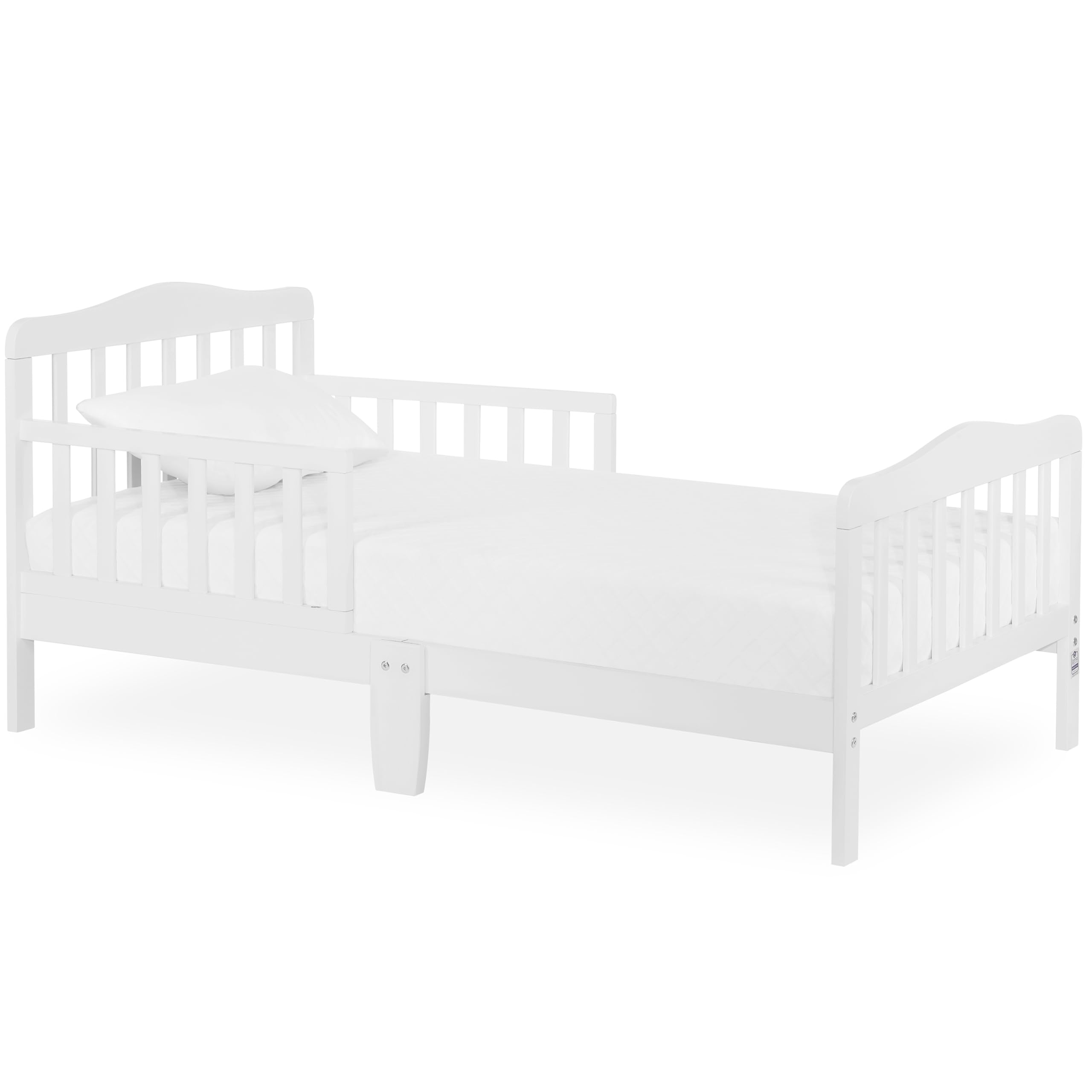
The Dream On Me Classic is the white arched toddler bed in this group, and its solid-pine GREENGUARD Gold build reads as nursery furniture rather than a character add-on. The frame uses the same crib-sized footprint, takes a standard crib mattress, includes two guardrails, and handles the usual 50-pound toddler-to-preschool window.
This frame fits parents who want a neutral, certified-wood first bed and are prepared for a patient build with some part matching before the crib moves out. The dowel-based assembly is the biggest hurdle rather than a sign of a weak frame once it is fully together.
Pros
- Solid pine frame with GREENGUARD Gold certification and a neutral white finish.
- Sturdy once fully assembled, with attached guardrails and room for a toddler through preschool.
- Classic arched design blends into traditional nursery decor.
Cons
- Dowel-based assembly can run long and hardware alignment may frustrate.
- Some pine pieces arrive cracked or dowels split during installation.
This is the white, arched first bed for parents who value certified wood construction and a nursery look that will not date in a few years.
Best for Siblings Sharing Rooms
Max & Lily Low Twin Bunk
Key Features
- Safety & Rails: 14-in guardrails; steel joints
- Mattress Size: Twin, 5-8 in thick
- Weight Limit: 400 lb
- Profile Height: 49-in low bunk
- Material & Finish: Solid pine
- Price: Premium
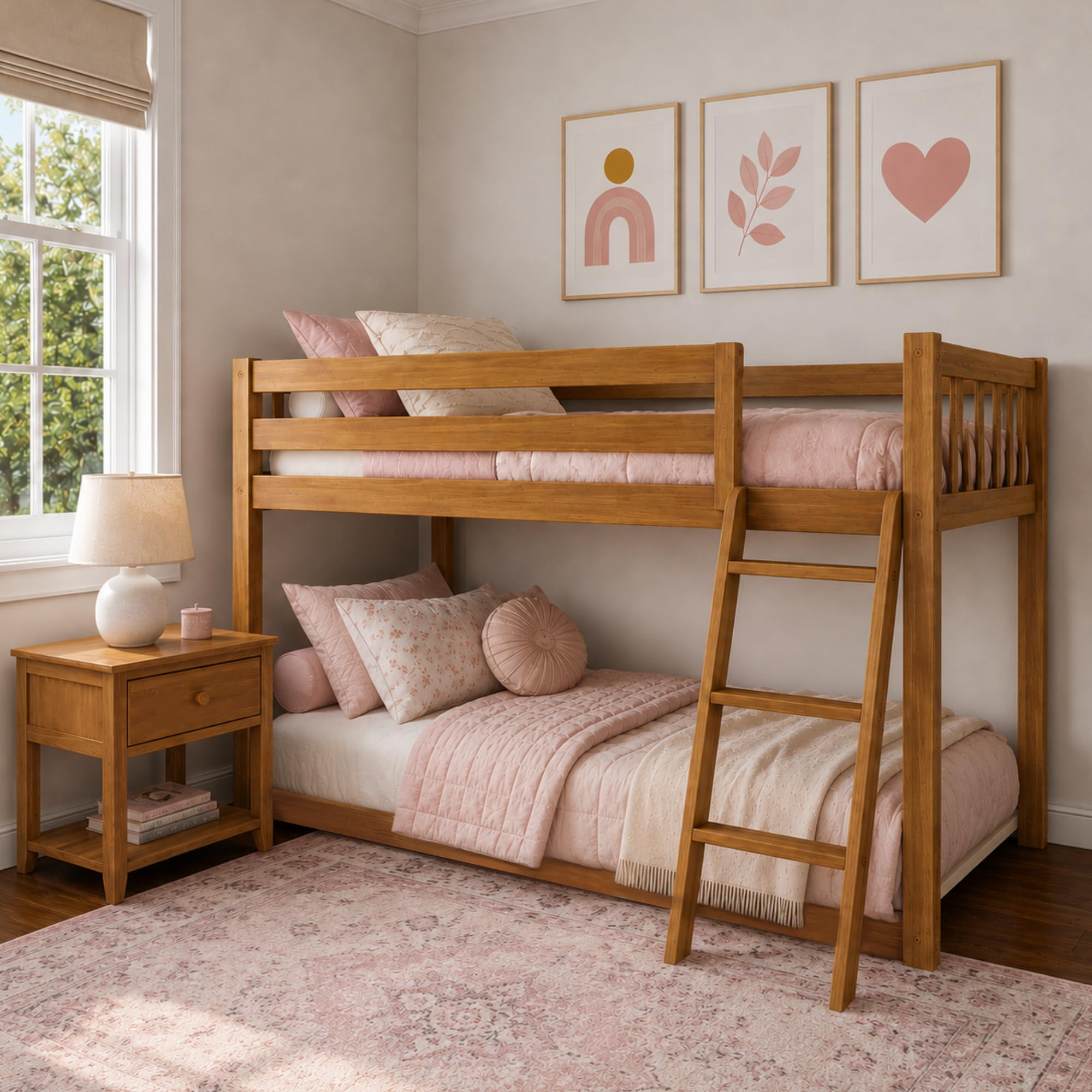
Solid pine construction and a 49-inch overall height make this low twin bunk manageable for young kids, and the twin-over-twin layout with 14-inch guardrails and a 400-lb capacity suits two siblings sharing a room. The low deck removes most of the fall risk that comes with taller bunk beds.
This fits parents who want a solid-wood frame with a kid-friendly height and are prepared for a two-person build. Boards can arrive split or cracked, so set aside time to inspect each piece before and during assembly; families needing two separate twin beds should look at non-bunk options.
Pros
- Solid pine frame with a 400-lb capacity carries two kids over the long haul.
- Low 49-inch height and 14-inch guardrails keep young sleepers close to the floor.
- Pecan finish looks clean in a shared room without leaning on character themes.
Cons
- Picture-only assembly instructions can make setup a longer project than expected.
For siblings sharing a room, this low bunk combines solid wood, a low fall height, and a 400-lb rating.
Best for Disney Character Fans
Delta Minnie Toddler Bed
Key Features
- Safety & Rails: JPMA; 2 guardrails
- Mattress Size: Standard crib mattress
- Weight Limit: 50 lb
- Profile Height: 26.18-in tall
- Material & Finish: Plastic / steel frame
- Price: Budget
The strongest licensed-character bed in this set, the Minnie Mouse frame makes the move out of the crib feel like a treat. Attached guardrails and standard crib-mattress sizing keep the switch simple, while the compact plastic-and-steel build fits small bedrooms without dominating them.
This budget bed suits toddlers under 50 lb who need a favorite character to get excited about sleeping in their own room. Families set on a neutral or wood frame will find that option elsewhere in this lineup; here, plastic construction is the tradeoff for the Disney look. At setup, press each guardrail into its snap to confirm it is fully seated.
Pros
- Attached guardrails and standard crib-mattress fit simplify the move from crib to first bed.
- Minnie Mouse styling gives toddlers a reason to want their own bed.
- Assembly is quick enough for a same-day switchover.
Cons
- Side rail snap fit can be inconsistent; check the attachment and reinforce if needed.
For a Minnie-obsessed toddler, this budget frame delivers the character payoff without the commitment of a bigger bed.
Best for Small-Room Storage Daybed
Hasuit Twin Corner Daybed
Key Features
- Safety & Rails: No guardrails
- Mattress Size: Twin, no box spring
- Weight Limit: 900 lb
- Profile Height: 29.7-in tall
- Material & Finish: Engineered wood, metal
- Price: Mid-Range
Hasuit’s Twin Corner Daybed packs a twin sleep surface, a bookcase headboard, two storage drawers, LED lighting, and charging ports into a corner footprint that might otherwise sit unused. The frame feels stable under active use, and the storage drawers offer enough room for bedding, clothes, or toys. The charging station and light modes turn the bed into the main event of a small bedroom.
This layout suits a tween or teen in a shared or compact room. Skip it for toddlers: there are no guardrails. Assembly is the tradeoff: the picture-only instructions are involved and need interpretation, and the drawers roll on wheels rather than smooth tracks. Set aside a few hours, and check the positioning before tightening.
Pros
- Frame feels stable and well-built under everyday kid use, with the 900-pound capacity to back it up.
- Storage drawers and bookcase headboard absorb the clutter of a small bedroom.
- LED lighting and charging ports make it a self-contained sleep and study spot.
Cons
- LED strip adhesive can come loose after installation and may need re-securing.
- App-based LED controls can frustrate buyers who prefer a simple physical light switch.
For a small bedroom, the Hasuit corner daybed is the compact setup that gives a tween or teen sleeping space plus storage, lighting, and charging without crowding the floor.
Best for Older Kids’ Twin
SHA CERLIN Butterfly Twin Bed

Key Features
- Safety & Rails: No guardrails
- Mattress Size: Twin, no box spring
- Weight Limit: 400 lb
- Profile Height: 46-in tall
- Material & Finish: Iron/steel, wood accents
- Price: Mid-Range
A decorative youth twin bed with a butterfly headboard and steel frame needs no box spring, leaving storage room below. The paint can arrive scratched or chip, so cosmetic touch-ups may be part of ownership. No guardrails and standard twin height make this for ages 6 and up, not toddlers.
Pros
- Butterfly headboard gives a pretty, distinctive look for a girl’s or teen’s room.
- Steel frame supports a standard twin mattress without a box spring.
Cons
- Paint or finish can arrive scratched or chip with use, so the surface may need care.
For a child 6 or older who wants a decorative twin bed with under-bed storage, this works — if you can accept possible finish touch-ups.
Best for Budget Pine Bed
Dream On Me Sydney Toddler Bed

Key Features
- Safety & Rails: GREENGUARD; 2 guardrails
- Mattress Size: Full-size crib mattress
- Weight Limit: 50 lb
- Profile Height: 28-in tall
- Material & Finish: New Zealand pine; GREENGUARD
- Price: Budget
A GREENGUARD Gold pine frame at a budget price, with a cute miniature-bed look that fits black and non-character nurseries. Assembly can frustrate: screws may strip and some units arrive with missing or stripped hardware, so check parts before starting. It suits value-focused families needing a second bed, though buyers wanting heirloom-level sturdiness should pass.
Pros
- Cute miniature-bed look in black fits non-character nursery themes.
- Transition size accepts a full-size crib/toddler mattress, easing the move from crib.
Cons
- Screws can strip and some units arrive with missing hardware, so assembly may require troubleshooting.
Choose this for a second bed or budget nursery that needs certified pine and a neutral black look.
How to Choose
A kids bed is a furniture purchase first and a theme purchase second; the right frame fits the child’s size, room, and existing mattress.
Safety Certifications and Guardrails
Attached guardrails remove the gap between bed and rail that portable rails create. JPMA certification sets a construction baseline, and GREENGUARD Gold confirms lower emissions. The rail needs to sit flush and lock tightly.
Certifications do not make a bed indestructible, but they separate purpose-built toddler frames from generic twin frames. Check the rails after assembly; the snap fit is the weak point on budget frames.
Mattress Compatibility
Most toddler beds are sized for a standard crib mattress, about 52 x 28 inches, so moving the existing mattress into the frame is usually the cheapest transition. Toddler and twin beds are separate purchases; twin compatibility only begins when you choose a twin or low-bunk frame.
A twin frame should specify mattress thickness. Too thick a mattress lowers the effective guardrail height and makes the climb steeper.
Weight and Age Limits
Toddler beds generally stop at 50 lb because that is where a crib mattress sits too low for safe climbing and joints see more stress. Near that weight, skip the toddler frame and go to a low twin bed.
Otherwise you buy a replacement within months.
Low Profile and Floor Height
A low frame reduces fall risk, but keep the mattress off the floor for airflow. A platform or slat base gives low height without moisture buildup.
For bunks, the top height matters more than the lower profile. A 49-inch low bunk keeps the upper bed close enough for young children.
Material and Finish
Solid wood and steel hold up better than engineered wood and plastic under daily use, and GREENGUARD Gold indicates lower emissions for a bedroom where a child sleeps every night.
The fragile parts are cosmetic: canopy rods, decals, stickers, and 3D accents. A neutral frame with character added through bedding and wall decor will look intact longer.
FAQ
Can I reuse my crib mattress in a toddler bed?
Yes, for the vast majority of toddler beds. The standard toddler frame is built around a full-size crib mattress, roughly 52 x 28 inches, so the cheapest transition is usually to move the existing mattress into the new frame. Check the bed’s mattress size before assuming a twin mattress will fit; toddler beds are not twin beds.
Why does my toddler bed’s canopy keep falling down?
Budget canopy beds use thin metal or plastic rods that hold the fabric at tension points, and any tug from a child can bend them out of shape. Reinforcing the joints with zip ties or replacing the rods usually solves it. If you want a frame you never have to repair, skip the canopy and choose a solid headboard instead.
How thick can a mattress be before bunk-bed guardrails stop being safe?
A bunk mattress should sit low enough that the top of the guardrail still rises at least five inches above the mattress surface. Most low bunks specify a 5- to 8-inch thick mattress because thicker foam changes the effective rail height. Measure the rail and the mattress thickness before assembling the upper bunk.
Do floor toddler beds need a plywood base or can the mattress sit directly on the floor?
A frame with slats or a solid base is better than placing a mattress directly on the carpet. Direct floor contact blocks airflow, lets moisture build up under the mattress, and makes it harder to keep the sleep surface clean. For a true floor bed, look for a low platform with ventilation rather than a mattress on the ground.