
This post contains affiliate links. We may earn a small commission when you buy through our links — at no extra cost to you.
Bedroom dehumidifiers split into two practical camps: thermoelectric units that whisper and compressor units that actually extract water. The first are small, light, and quiet, but their daily moisture removal is often closer to a cup of water than the ‘1000 sq ft’ claims on the box. The second camp removes moisture at many times the rate, but adds weight and a low hum.
That trade-off matters most in a bedroom, where noise and sleep quality sit right next to the humidity problem. A unit that never fills its tank may make you feel safer without changing the room. The right choice depends on room size, how damp the space gets, and whether you can run a drain hose to avoid frequent emptying.


Best for Medium Bedrooms
Aiusevo 21 Pint
Key Features
- Daily Extraction: 21 pints/day
- Tank Size: 0.52 gal
- Stated Coverage: 1500 sq ft
- Weight: 15.3 lb
- Price: Mid-Range
At 21 pints per day, this is a true compressor dehumidifier rather than a thermoelectric shelf unit. It has enough extraction to lower humidity in a bedroom or basement, and it does so without the high fan whine you get from smaller units. The included 3.28 ft drain hose makes continuous operation easy once you have a drain location; the hose connects directly.
At normal operation, the compressor hum is present but moderate; most people can sleep with it, and in a basement or garage it disappears into the background. The 21-pint rating translates to a noticeable drop in dampness in rooms around 500 sq ft. The 0.52-gallon tank is small for the capacity, so plan to use the included drain hose for continuous running rather than emptying the reservoir twice a day.
This is a floor-unit purchase for bedroom and basement owners who want real extraction, not a tiny nightstand accessory. It is heavier than the compact thermoelectric options in this set, so moving it between rooms is possible but not a selling point. Buyers who want Wi-Fi control should look elsewhere; those who want solid moisture removal without smart features will find this fits the bill.
Pros
- Operates quietly enough for a bedroom at a true 21-pint extraction capacity.
- Pulls moisture effectively from basements and larger rooms without the slow wicking of thermoelectric units.
- Includes a 3.28 ft drain hose and requires little setup out of the box.
Cons
For a bedroom or basement where the goal is actual extraction, this is a strong value: real compressor power, a drain hose for continuous runs, and no smart features you have to pay for.
Best for Small Bedrooms
Tenergy Sorbi
Key Features
- Daily Extraction: 0.75 L/day
- Noise Level: 35-42 dB
- Tank Size: 1000 ml
- Stated Coverage: 200 sq ft
- Weight: 6 lb
- Price: Mid-Range
The Tenergy Sorbi pairs True HEPA filtration with thermoelectric dehumidification, so a small bedroom gets one 6-lb appliance for airborne allergens and condensation instead of two separate machines. Low-speed operation sits near 35 dB, and touch controls, adjustable air speed, and auto shutoff keep the routine simple.
That combination fits allergy-prone sleepers in bedrooms, nurseries, or home offices up to 200 sq ft who want quieter, lighter hardware than a compressor unit. Daily extraction maxes at 0.75 L, which maintains comfortable humidity in normal conditions but won’t dry a very damp or larger room.
Pros
- Cuts airborne allergens while reducing condensation, pairing True HEPA filtration with dehumidification in a single unit.
- Runs quiet enough for overnight bedroom use, staying near a whisper on the low-speed setting.
- Six-pound build fits on nightstands, closet shelves, and RV counters without crowding a small room.
Cons
- In a quiet bedroom, fan noise can become noticeable in some units after several months of use.
Small bedrooms that need both HEPA filtration and gentle moisture control get both in a quiet, lightweight unit.
Best for Large Bedrooms
Midea 22 Pint
Key Features
- Daily Extraction: 22 pints/day
- Noise Level: 47 dBA
- Tank Size: 0.8 gal
- Stated Coverage: 1500 sq ft
- Weight: 33.5 lb
- Price: Premium
The connected compressor unit in this set brings Wi-Fi, app control, and Alexa voice commands to a 22-pint frame. Extraction is roughly ten times what compact thermoelectric units manage, and rolling casters make it easy to move between rooms.
It fits buyers who want smart-home control and serious moisture removal in a primary bedroom plus adjacent spaces. The 47 dBA hum is noticeable in quiet overnight use, so it is a better match for moderate humidity and open layouts than for ultra-sensitive sleepers. At 33.5 lb, it is a roll-around appliance, not a shelf-size unit.
Pros
- Strong moisture removal performance handles a primary bedroom plus nearby spaces.
- Five-minute setup and rolling casters make it easy to move between rooms.
- Build quality reads as a well-made machine for its price.
Cons
- Long-term performance can vary between units; an occasional unit may lose extraction ability over time.
The Midea is the connected pick when you want real extraction, app control, and room-to-room portability from a bedroom-capable compressor unit.
Best for Small Bedrooms
BEDRED 95OZ
Quiet, compact, and budget-friendly, the BEDRED 95OZ pairs a 7-color ambient light with low operating noise and a footprint that slips into a bedroom or bath. The 95 oz tank and auto shutoff handle overnight runs without fuss. It doesn’t have the extraction muscle of larger compressor units, but it behaves like a nightlight that happens to manage moisture.
Best for apartment dwellers and budget-conscious buyers with one small enclosed room. The stated 1000 sq ft coverage is optimistic; treat this as a bedroom or closet unit, not a basement machine. In those small spaces, the low noise and ambient glow make it easy to keep running daily.
Pros
- Quiet enough for a bedroom, so it won’t disturb sleep.
- Pulls moisture from small bathrooms, closets, and bedrooms.
- Budget-friendly to run and doubles as a 7-color nightlight.
Cons
- Daily water collection can be minimal in some humid conditions, so it’s best suited to light moisture control.
For one small room, this quiet dehumidifier and nightlight combo is a budget-friendly way to keep moisture in check.
Best for Micro Spaces
Eva-Dry EDV-1100
Key Features
- Daily Extraction: 0.23 L/day
- Noise Level: 33 dB
- Tank Size: 16 oz
- Stated Coverage: 122 sq ft
- Weight: 1 lb
- Price: Mid-Range
At 33 dB and just 1 lb, the Eva-Dry EDV-1100 is the quietest and lightest option in this set, with a long service record of keeping closets, wardrobes, safes, and small RVs dry.
Spaces up to 122 sq ft are the practical ceiling, so this unit belongs in a closet or gun safe, not a whole bedroom. For ultra-light sleepers who need silent operation in a small enclosed space, it is the right fit.
Pros
- Whisper-quiet 33 dB operation suits bedrooms, closets, and any space where noise bothers you.
- One-pound frame fits on shelves, in wardrobes, or into tight RV cabinets.
- Steady moisture removal in micro-spaces such as safes and bathrooms.
Cons
- Very low daily water removal; it maintains dry air but will not fix active dampness.
- Some units can lose extraction capacity after months of use.
The quietest way to guard a closet or safe from dampness without adding bulk.
Best for Small Bedrooms
ToLife 95OZ
Key Features
- Daily Extraction: 1 L/day
- Noise Level: under 30 dB
- Tank Size: 95 oz
- Stated Coverage: 1000 sq ft
- Price: Budget
The ToLife keeps a small footprint while adding a 95 oz tank and an under-30 dB sleep mode, making it a good fit for bedrooms where continuous compressor noise would be intrusive. The 7-color LED light adds ambient low-light glow without making the unit feel like a novelty. For overnight use, the large tank means fewer interruptions, and sleep mode keeps the room quiet.
This suits a bedroom owner who wants fewer tank empties and a quiet overnight run. Auto shut-off can vary, so check the tank rather than trusting the indicator.
Pros
- Under-30 dB sleep mode keeps bedroom noise minimal overnight.
- The 95 oz tank cuts emptying frequency for continuous overnight use.
- Noticeably reduces dampness in bedrooms, bathrooms, and small living spaces.
Cons
- Daily extraction is modest; it will not keep pace with a high-humidity basement.
For a bedroom-sized space, the ToLife delivers the two features that matter here: a large tank and a genuinely quiet sleep mode.
Best for Very Small Spaces
TABYIK 35OZ
Key Features
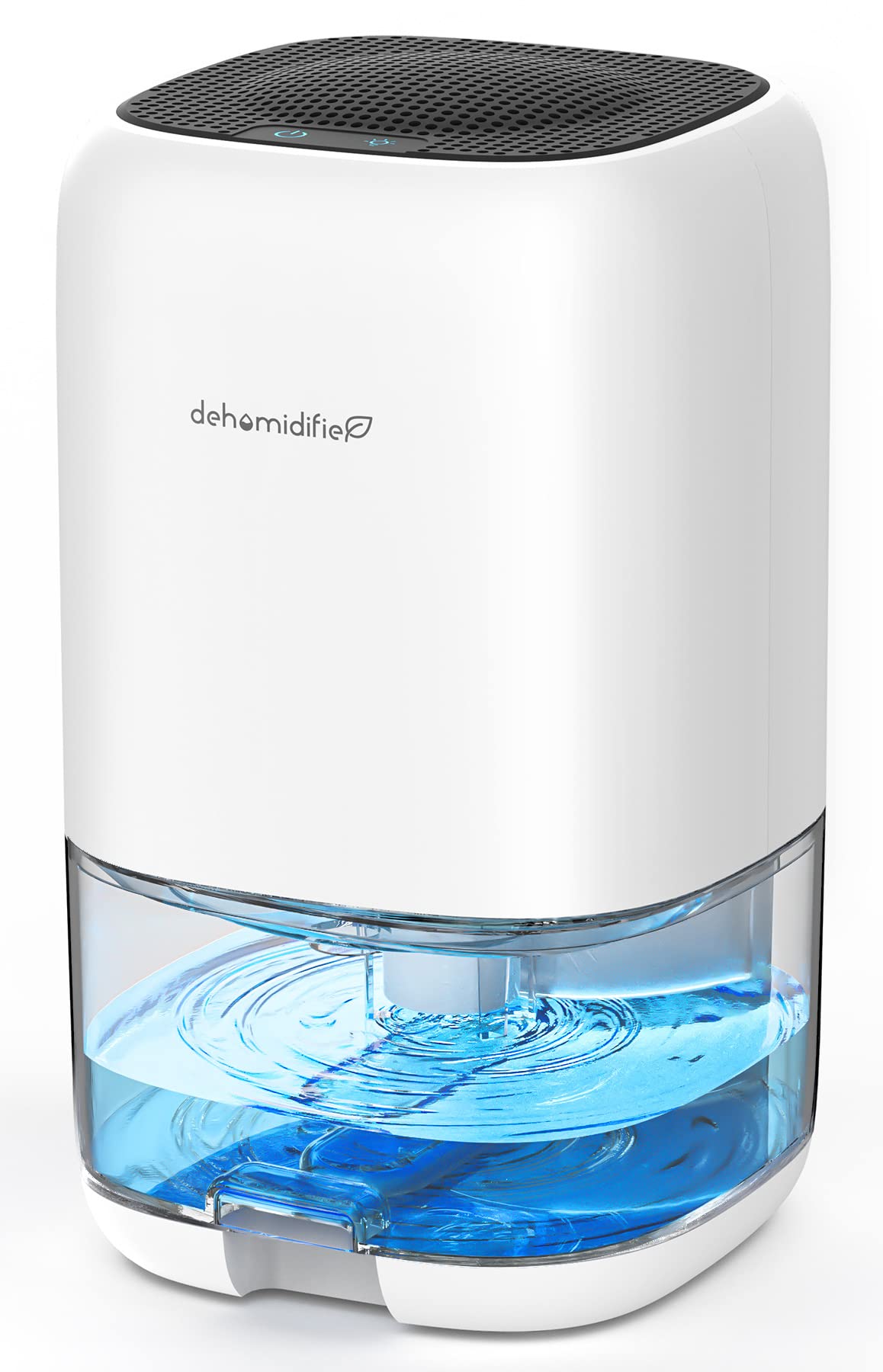
- Daily Extraction: 0.45 L/day
- Noise Level: 28 dB
- Tank Size: 35 oz
- Stated Coverage: 280 sq ft
- Weight: 2.2 lb
- Price: Budget
This 2.2 lb dehumidifier pairs 28 dB operation with a 7-color nightlight in a footprint for shelves, closets, and RVs. It handles dampness in tight small rooms and auto-shuts off when the 35 oz tank fills. The 280 sq ft coverage assumes an enclosed space, not an open master bedroom. Durability varies; some units may lose effectiveness after months, keeping it below top tiers.
Pros
- Ultra-compact 2.2 lb design fits shelves, closets, and RV counters easily.
- Quiet operation plus a 7-color nightlight suits small bedrooms.
Cons
- Long-term durability can vary; some units may become less effective after months.
Best for a very small bedroom, closet, or RV where the compact footprint and nightlight matter more than long-term extraction consistency.
Best for Tiny Bathrooms
SANVINDER 25OZ

Key Features
- Daily Extraction: 0.45 L/day
- Noise Level: under 35 dB
- Tank Size: 25 oz
- Stated Coverage: 320 sq ft
- Weight: 2.2 lb
- Price: Budget
Under 35 dB and drawing just 23W, this 2.2 lb unit runs quietly enough for a shelf in a tiny bathroom or closet. Extraction can be inconsistent, so its best role is a budget secondary unit for micro-spaces rather than a primary moisture remover.
Pros
- Quiet 23W operation lets it run in a small bedroom without calling attention to itself.
- Compact 2.2 lb body fits on shelves, countertops, and RV counters without crowding.
Cons
- Service life can vary; a unit may lose effectiveness after several months.
A tiny bathroom or closet shelf is the right home when silence matters more than extraction.
Best for Small Bedrooms
Spacekey 95OZ

Key Features
- Noise Level: 20-40 dB
- Tank Size: 95 oz
- Stated Coverage: 1000 sq ft
- Price: Budget
Spacekey keeps noise low (20-40 dB), carries a 95 oz tank, and adds a sleep mode and 7-color light at a budget-friendly price. The compact body suits a small bedroom or office. The 1000 sq ft coverage figure is not realistic; treat this as a small-room unit, with long-term durability the tradeoff at this price.
Pros
- Runs quiet enough for a bedroom, particularly in sleep mode, without calling attention to itself.
- Seven-color LED light works as a soft nightlight and adds a useful ambient glow.
Cons
- For rooms near 600 sq ft, moisture extraction is modest; plan on using it in a smaller bedroom or office.
This fits when you need a quiet, compact dehumidifier for a small bedroom and want the nightlight plus sleep mode without paying for basement-level capacity.
Ninesky 95Oz
NineSky 95OZ

The NineSky combines a 95 oz tank, quiet thermoelectric operation, and a 7-color ambient light in a compact shell. At this price it’s an easy pick for a small bedroom or closet. The stated 1000 sq ft coverage is optimistic; expect it to handle a compact enclosed space rather than a whole floor.
Pros
- 95 oz tank plus auto shutoff means fewer empty stops during normal bedroom use.
- 7-color ambient light adds a low-level nightlight without extra clutter.
Cons
- Extraction is slow for this class, so it works best for steady dampness control instead of rapid drying.
For a small bedroom with mild dampness, this is a low-cost way to add a nightlight and gentle moisture control.
Best for Small Rooms
OWAAE 95OZ
Key Features
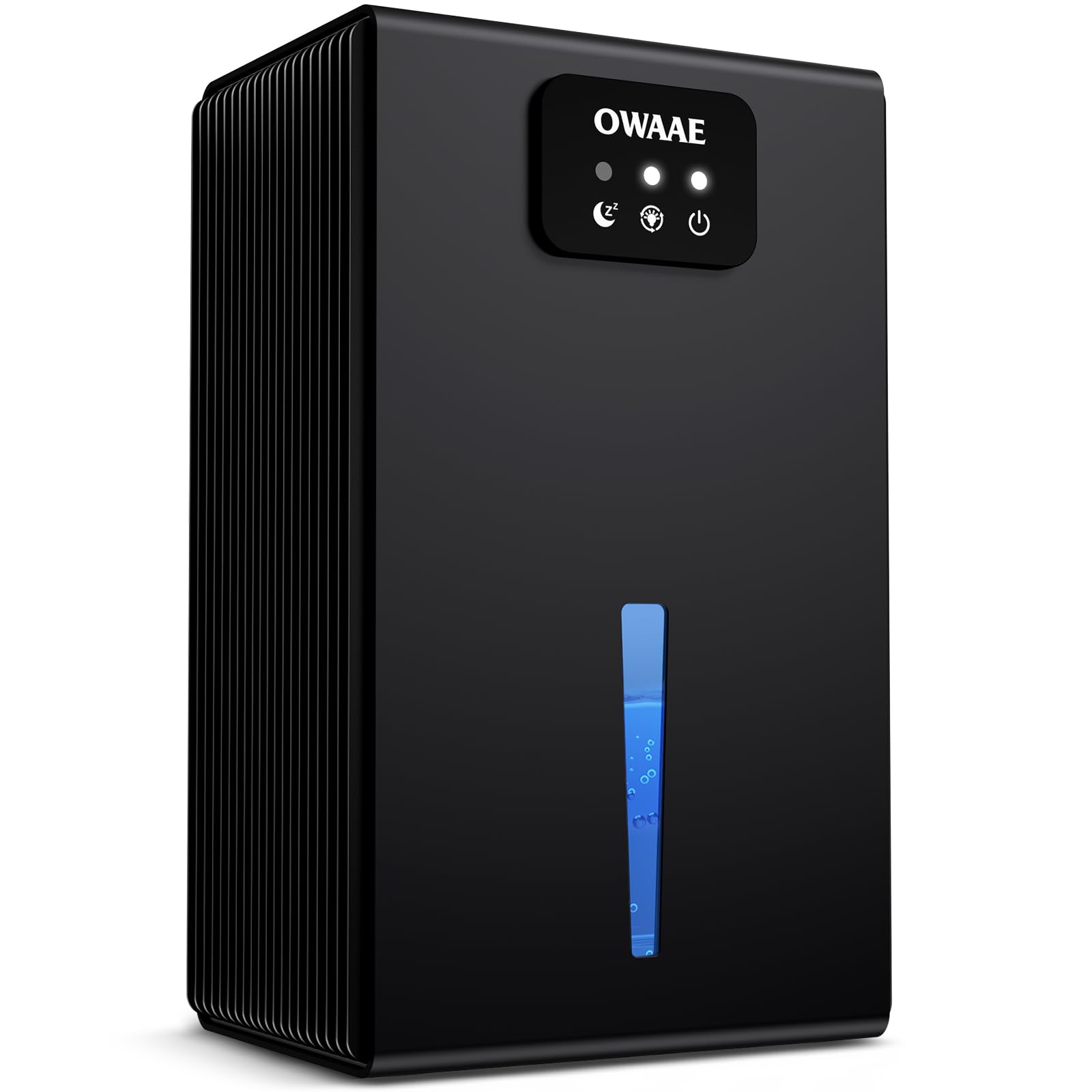
- Noise Level: under 30 dB
- Tank Size: 95 oz
- Stated Coverage: 1000 sq ft
- Price: Budget
OWAAE’s compact black dehumidifier pairs a 95 oz tank and auto shutoff with an under-30 dB sleep mode. The 7-color LED light keeps it bedroom-friendly. The 1000 sq ft coverage claim is optimistic; treat it as a small-room unit. Extraction and durability can vary, so early adopters should judge performance in their own bedroom.
Pros
- Under-30 dB sleep mode suits quiet bedrooms, and the 95 oz tank cuts down on emptying frequency.
- Compact black build with 7-color LED light fits unobtrusively on a shelf or nightstand.
Cons
- The 1000 sq ft coverage rating is optimistic; treat it as a small-room unit.
An entry-level choice for a quiet, good-looking bedroom dehumidifier when you don’t need compressor-grade moisture removal.
How to Choose
Check daily extraction before coverage claims; it decides whether the unit changes the room or just runs.
Daily Extraction Rate
Compressor dehumidifiers condense air over cold coils, so a 20-pint unit can pull a gallon or more per day. Peltier units use a cold plate and typically manage under a liter.
That gap shows in the tank: a 0.45 L/day unit can run for a week and collect almost nothing, while a 20-pint unit fills its reservoir in hours. Match extraction to room dampness, not box measurements.
Noise Level
Compressor units produce a low hum; thermoelectric units are nearly silent at first. Stated dB numbers often come from the lowest fan setting, so a quiet-rated unit can still bother light sleepers.
If you want white noise, compressor hum is fine. If you need silence, choose a Peltier model with a low dB figure and accept slower extraction.
Water Tank Size
Tank size matters only relative to extraction. A 95 oz tank on a 1 L/day unit can run for days; a 0.52 gal tank on a 21-pint unit may need emptying twice a day in damp conditions.
In a bedroom, frequent emptying makes people stop using the machine. A drain hose solves that for compressor units, but only if the unit sits near a floor drain or window.
Coverage vs. Reality
Coverage claims are optimistic, especially for thermoelectric units. A 1000 sq ft Peltier unit rarely keeps even a 300 sq ft bedroom dry because its extraction rate is too low for the air volume.
Use coverage as a ceiling, not a promise. For a standard bedroom up to 200 sq ft, a small Peltier unit can help; for larger or humid rooms, choose a compressor unit.
Weight and Portability
Weight determines placement. A 33 lb compressor unit lives on the floor; a 2 lb unit can sit on a shelf without disrupting the room.
Think about daily logistics: emptying, moving, carrying upstairs. A heavy unit on casters can be easier than a compact unit you must lift every time.
FAQ
Why is my small 1000 sq ft dehumidifier only collecting a few drops of water?
Compact thermoelectric dehumidifiers use a small cooling plate that removes water slowly; the ‘1000 sq ft’ rating describes an ideal open-space condition, not what the mechanism can physically achieve. In a closed bedroom it will collect something, but in an open or low-humidity room it can look almost idle. If a tank stays empty, the room is too large or already dry for that unit. Use a compressor dehumidifier when you need measurable extraction.
Can a thermoelectric dehumidifier actually dehumidify a bedroom?
Yes, but only a small, closed one. Units rated around 0.4-1 L/day can reduce dampness in closets, bathrooms, and bedrooms up to roughly 200 sq ft, especially when run continuously. They cannot compete with a compressor unit in a larger or very humid bedroom. Set expectations by watching the water tank: if it fills, it’s working; if it stays dry, the space is too much for it.
How often should I empty a 35 oz dehumidifier water tank in a humid bedroom?
A 35 oz tank on a typical compact unit will fill roughly once every 1-3 days in a humid small bedroom, depending on how damp the air is. In high humidity, a 1 L/day unit can fill a 35 oz tank in just over a day. Check the tank every morning until you learn your room’s pattern.
Why does my dehumidifier stop collecting water after a few months?
Thermoelectric dehumidifiers often lose efficiency as dust builds up on the cold plate and the fan slows. Clean the air intake and cooling fins with a soft brush, and check the tank sensor for debris. Some budget units also use fans that wear out quickly, which is why a slightly higher-priced compressor model is often the better long-term buy.