
This post contains affiliate links. We may earn a small commission when you buy through our links — at no extra cost to you.
The most common complaint from car campers is waking up on a pad that went flat overnight or a foam slab that never fully expanded. Both trace back to the same mistake: buying a pad that matches the wrong use case. Car camping changes the trade-off equation because weight matters less than loft and insulation.
A thick self-inflating pad with a real R-value can feel like a bed, but it rolls into an 8-pound bundle. A lightweight air pad stores easily, yet it offers almost no ground insulation and depends on valves and seams that can leak. The choice is which trade-off fits your sleeping style and your trips.
The pads that do it well share a few traits: at least three inches of loft, a dependable inflation system, and enough width for your cot or tent floor. That combination decides whether you wake up rested.




Best for All-Season Car Campers
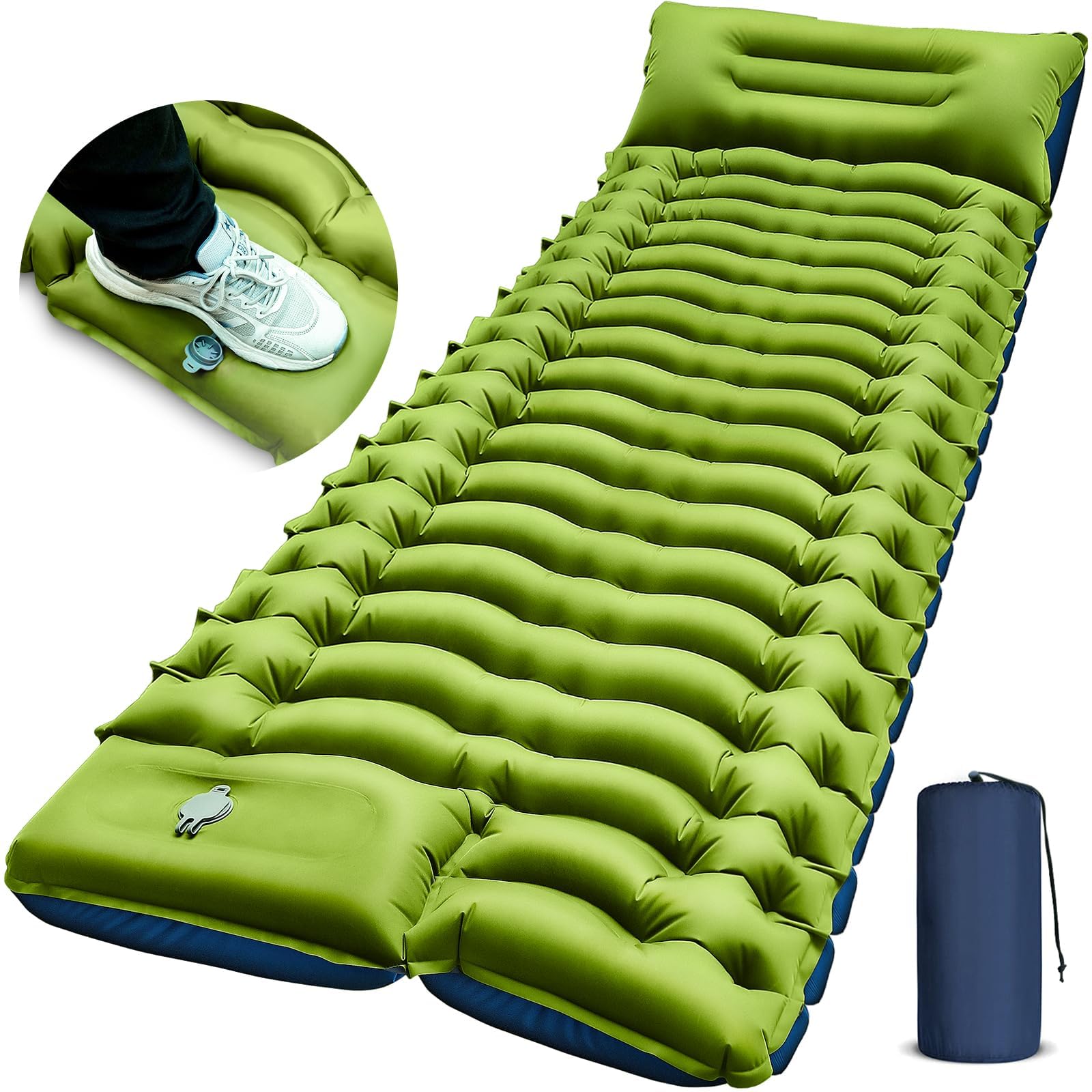
Elegear Self-Inflating Pad
Key Features
- Loft: 3.15 in
- Inflation: Self-inflating, foot assist
- Insulation: 9.5 R-value
- Packed Weight: 8.1 lb roll
- Air Retention: Two-layer valve
- Cot Width: 27 in wide
- Price: Mid-Range
3.15 inches of 26D memory foam gives this pad a bed-like feel, and the 9.5 ASTM R-value keeps cold ground from pulling warmth away. The built-in pillow saves packing one more item, and the noiseless 50D stretch-knit cover stays quiet when you shift at night. Side sleepers get enough loft to keep hips from bottoming out on a hard tent floor.
Opening the valve lets the foam expand on its own, so no pump or battery is needed; a quick breath to fine-tune firmness is enough. Deflation is just as direct: open both layers, roll toward the foot, and the included bag captures the roll without a struggle. The foam rebounds quickly after being packed away, so you are not waiting for the pad to ‘remember’ its shape. After a few trips, the setup and breakdown routine feels familiar enough to manage in the dark.
This pad suits side sleepers, cold sleepers, and larger campers who want support in a tent, on a cot, or across the back of an SUV. Self-inflation can be inconsistent between units, and the two-layer valve sequence is easy to confuse, so expect to assist the pad occasionally. This is a vehicle-camping pad, not a trail pad, and that is exactly the point.
The mid-range price undercuts comparably insulated pads, so the 9.5 R-value feels like a genuine upgrade rather than a marketing spec. The included bag and memory-foam build also mean less gear to remember; you do not need a separate pump, pad cover, or pillow. That simplicity is the real value for anyone who would rather spend the evening at camp than managing gear.
Pros
- 3.15 inches of 26D memory foam delivers a genuinely bed-like sleep surface without air-bladder wobble.
- 9.5 ASTM R-value provides real cold-weather insulation for winter ground sleeping.
- Self-inflates with no pump or battery required; just open the valve.
- Noiseless 50D stretch-knit cover and built-in pillow simplify the sleep setup.
Cons
- At 8.1 pounds, this is a heavy pad to carry any real distance from the car.
- The rolled package will claim a noticeable share of trunk space.
For cold-weather car, cot, and SUV campers who want memory-foam comfort without a pump, this pad turns the 9.5 R-value into a tangible improvement in sleep quality.
Best for Budget Mild Weather
FUN PAC Inflatable Pad
Key Features
- Loft: 3 in
- Inflation: Built-in foot pump
- Insulation: Not listed
- Packed Weight: 1.5 lb roll
- Air Retention: Valve-seal leaks possible
- Cot Width: 27 in wide
- Price: Budget
Three inches of inflated loft, a built-in foot pump, and side connector buttons make this a comfortable, fast-inflating budget air pad for car campers. The 78 x 27-inch surface fits standard adult frames, and the 1.5-pound weight stays light enough for kids to carry.
Unlike the top pick’s self-inflating memory-foam build, this pad trades all-season insulation for a lighter, faster setup that packs down for trunks and tents. There is no R-value rating, so cold-ground insulation is not part of the package; the insulated foam top pick covers that need. Mild-weather tent campers, scout groups, SUV sleepers, and families wanting connectable singles get the greatest value here.
Repeated scout trips and regular car-camping weekends sit within the pad’s comfort zone, and the foot pump deflates quickly enough that packing up is as easy as setting up.
Pros
- Built-in foot pump inflates the pad quickly and deflates it in seconds.
- Three-inch loft and 78 x 27-inch surface fit standard adult frames comfortably.
- Side connectors link multiple pads into a family-size sleep setup.
Cons
- A valve-seal leak can let the pad deflate overnight even when no puncture caused it.
This is the budget pad to grab when your camping season stays mild and your trips are car-based.
Best for Cots and Guests
CYMULA Memory Foam Pad
Key Features
- Loft: 3 in
- Inflation: None needed
- Insulation: Not listed
- Packed Weight: 7.5 lb roll
- Air Retention: No air to lose
- Cot Width: 24 in wide
- Price: Mid-Range
CYMULA’s 3-inch CertiPUR-US memory foam pad is the unroll-and-sleep option in this car-camping lineup. The dense foam supports cot slats and bare tent ground without valves, pumps, or air-retention checks, and the removable washable cover keeps the same pad presentable on a guest-room floor. It is a functional replacement for an air mattress for owners who prefer stable support over adjustable firmness.
This is the pick for cot sleepers and car/tent campers who want foam comfort without inflation setup, and for anyone who needs a spare bed indoors. It is not for backpackers or anyone needing a compact roll; the rolled size is bulky and the 7.5-pound pad belongs in a trunk. Vacuum-packed foam can arrive below the 3-inch mark until it has a couple of days to loft, so open it before the trip.
Pros
- Dense 3-inch foam gives cot and tent-floor sleepers a stable surface without pump or valve.
- Removable washable cover and sturdy construction make it practical for repeated indoor/outdoor use.
- Included travel bag and straps handle the transport job for car campers.
Cons
- The 24-inch surface suits average cot sleepers; broader sleepers who toss and turn will find less room to spread out.
- For cold-ground camping, the pad has no listed insulation rating, so an insulating layer underneath is the safer call.
The comfortable middle ground for no-inflation camping: dense foam support on cots and tent floors, with a washable cover that makes the transition to guest bed effortless.
Best for Couples and Families
FNARMW 6-inch Double Pad
Key Features
- Loft: 6 in
- Inflation: Built-in foot pump
- Insulation: Not listed
- Packed Weight: 5 lb roll
- Air Retention: Leak risk reported
- Cot Width: 55 in wide
- Price: Mid-Range
The FNARMW behaves like a spare mattress rather than a camp pad: 6 inches of loft, 55 inches of width, integrated pillows, and a built-in foot pump that brings the whole double surface up without separate gear. The 6-inch height gives side sleepers enough cushion for hips and shoulders, while the wide base keeps two sleepers from spilling off during the night. Fast setup is a real benefit here, and the bed-like surface is the main reason couples and families stay comfortable through the night.
Best for car-camping couples and families who set up in a tent, on the ground, or in a truck bed and care more about comfort than packed size. The 5-lb roll is compact for a double pad, but it is not backpacking gear. Active kids and toss-and-turn sleepers are covered too, thanks to the stable platform.
Pros
- Bed-like 6-inch loft and 55-inch width give two sleepers a stable shared surface that feels like a real mattress.
- Built-in foot pump inflates and deflates the pad without extra gear or battery power.
- Holds pressure through full nights and multi-day camping stays, with enough cushion for side sleepers.
Cons
- Air retention can vary between units; a pad may lose pressure after a few hours or on first use.
Couples and families who camp from the car get the closest thing to a shared bed on the tent floor without the price or bulk of an air mattress.
Best for Side Sleepers
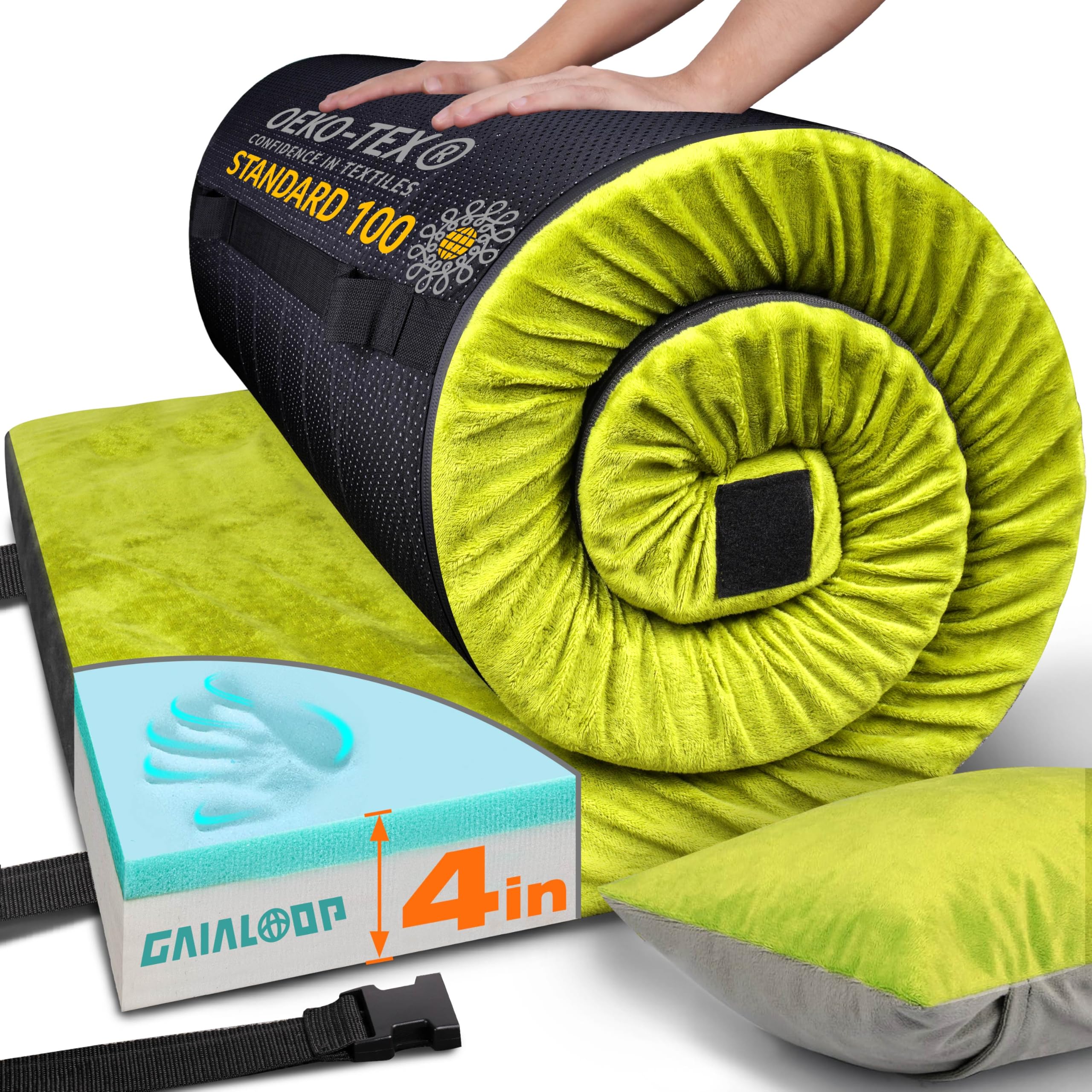
Gaialoop 4-inch Memory Foam Pad
Key Features
- Loft: 4 in
- Inflation: None needed
- Insulation: Not listed
- Packed Weight: 11 lb roll
- Air Retention: No air to lose
- Cot Width: 24 in wide
- Price: Premium
The layered construction combines a 30D support core with a 40D memory-foam top, producing a bed-like loft that the slimmer 3-inch option in this lineup cannot match. The removable cover is waterproof-coated and washable, which keeps the foam dry on damp tent floors and makes cleanup simple.
The 72 x 24-inch surface works on the ground, over a cot, or across an SUV sleep area, and side sleepers get stable cushioning under the hips and lower back. Cot users can layer it over a cot frame as a plush topper, and the 11-pound weight is manageable for car, truck, and van campers who are not carrying gear on foot.
This pad is for side sleepers with back or hip pain who drive to camp and want a bedroom-like surface rather than a compact air pad. Backpackers and campers who prioritize pack size over loft are better off with a lighter inflatable.
Pros
- Build quality holds up better than a typical air mattress, with a stable bed-like sleep surface.
- The layered 4-inch foam suits car camping, truck beds, and cot setups without needing an air pump.
- The 72 x 24-inch footprint fits cots and SUV sleep areas cleanly, making it a practical vehicle-camping layer.
Cons
- Cold-weather foam can feel firm, so sleepers who want deep sink-in softness may be disappointed.
- Heavier campers can compress the foam closer to the ground than the 4-inch spec suggests.
- Rolling the pad tight enough to fit in the included storage bag takes patience and upper-body effort.
For side sleepers with back or hip pain, the Gaialoop’s 4 inches of layered foam provide the closest thing to a bed among the non-inflatable options here.
Best for Budget Cold Weather
Wevelel Memory Foam Pad
Key Features
- Loft: 3.1 in
- Inflation: Self-inflating, foot assist
- Insulation: 9.5 R-value
- Packed Weight: 6.59 lb roll
- Air Retention: Overnight leak possible
- Cot Width: 27 in wide
- Price: Budget
This self-inflating memory-foam pad is the budget route to cold-weather car camping: a 3.1-inch loft and claimed 9.5 R-value give insulated support without a separate pump. The foot-assist valve tops off pressure, and firmness adjusts from soft to firm. The foam carries hips and shoulders well, helping side sleepers avoid the back pain that thin air pads can cause. Setup is mostly unrolling the pad and opening the valve; the roll stores easily in a trunk and travels well between tent and vehicle-floor setups.
This pad is a match for budget-focused car campers who want cold-ground insulation and can accept a 6.6-pound roll. Because QC varies, a pre-trip test is essential; it is not for buyers unwilling to fully expand and check the pad before a trip. For campers who take that precaution, it delivers the insulated support of pricier self-inflating foam pads without the premium price.
Pros
- Comfortable memory-foam support that carries hips and shoulders on tent floors and vehicle sleeps.
- Setup is mostly unrolling and opening the valve; the foot-assist top-off keeps things quick.
- Adjustable firmness from soft to firm makes it easier for side and back sleepers to get comfortable.
Cons
- A fresh unit can measure below 3.1 inches until the foam fully expands.
- Self-inflation can stall and a pad may lose air within a few hours, so an overnight check matters.
Winter car campers who want cold-ground insulation without the premium price get a thick, comfortable pad that stores as a roll.
Best for Family Tent Camping
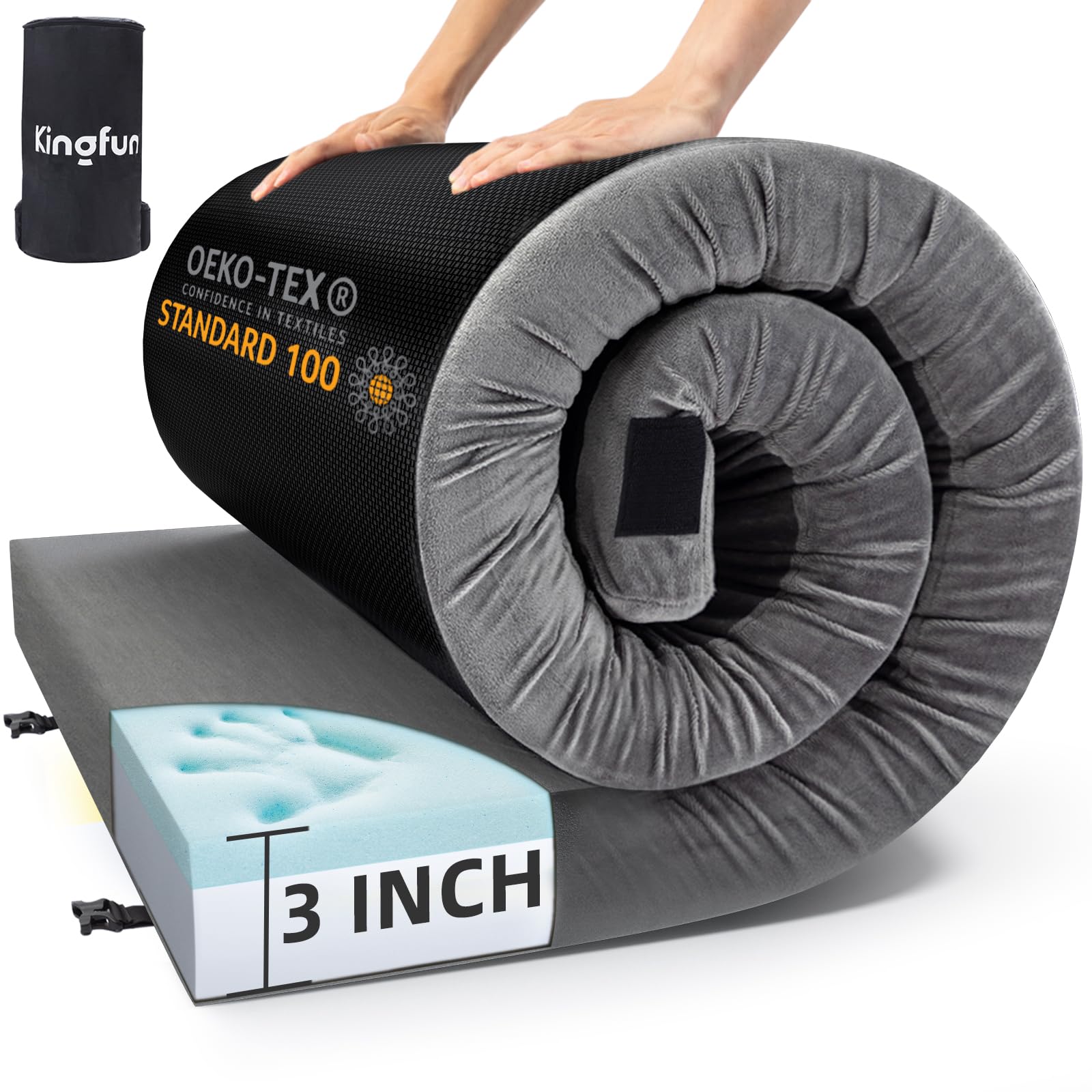
Kingfun 3-inch Memory Foam Pad
Key Features
- Loft: 3 in
- Inflation: None needed
- Insulation: Not listed
- Packed Weight: No weight listed
- Air Retention: No air to lose
- Cot Width: 30 in wide
- Price: Mid-Range
At 75 by 30 inches, this pad gives car campers a roomy, cushioned base with a soft TPU-coated cover and Velcro connectors that let two pads merge into a large bed. The foam is comfortable for side sleepers on tent floors, cots, and truck beds, and setup is simple. It falls behind the strongest foam pads on accessory quality and loft: the bag and buckles can wear through quickly, and vacuum-packed foam may need time to reach its full 3-inch height.
Pros
- Wide 75 x 30-inch memory foam surface with a soft TPU cover supports adult side sleepers on tent floors and cots.
- Works on tent floors, truck beds, cots, and guest-room floors, and two pads can be joined with Velcro.
Cons
- Storage sack and buckles can wear out within the first few packing cycles.
- Vacuum-packed foam may need several days to rebound and can sit below the advertised 3-inch height.
This pad fits family car campers who value sleep comfort over a compact carry system.
Best for Narrow Cots
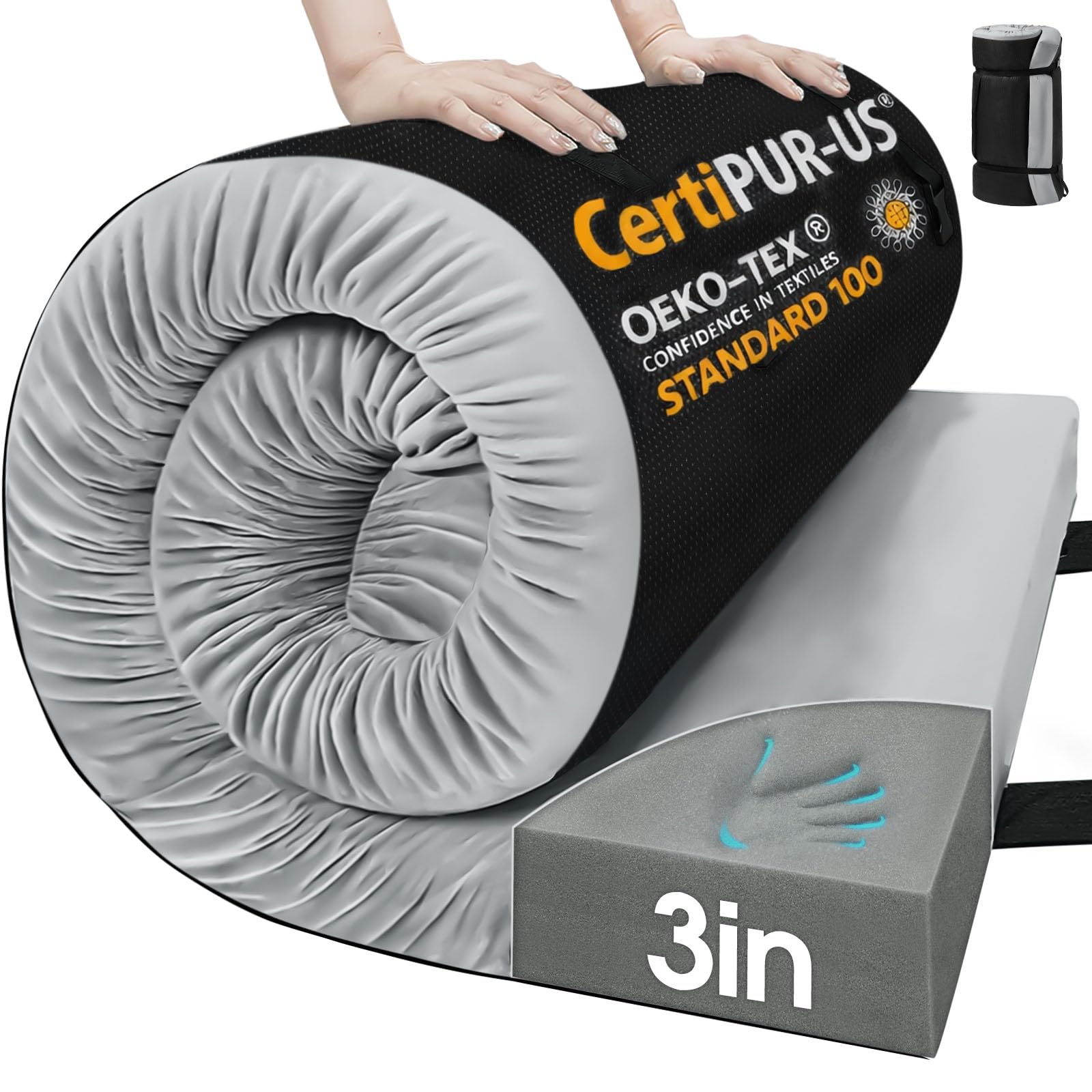
CYMULA Non-Slip Foam Pad
Key Features
- Loft: 3 in
- Inflation: None needed
- Insulation: Not listed
- Packed Weight: 6.4 lb roll
- Air Retention: No air to lose
- Cot Width: 24 in wide
- Price: Mid-Range
Built around a 3-inch memory foam core, this pad stays put on narrow cots and back-seat platforms thanks to integrated straps and rubberized non-slip dots. The removable cover washes easily, and the roll-up size suits car camping. The 24-inch width is too narrow for standard-width cots, so measure first; this makes it a fit-dependent cot pad rather than a universal car-camping mattress.
Pros
- Three inches of memory foam deliver stable sleep support on cots and in cooler weather.
- Integrated straps and rubber dots stop the pad from sliding on narrow cots and truck back-seat platforms.
Cons
- 24-inch width suits narrow cots only; measure before using it on a wider cot.
Fits a narrow cot or back-seat platform well once you confirm the surface dimensions match.
Best for Solo Car Campers
FNARMW 5-inch Inflatable Pad

Key Features
- Loft: 5 in
- Inflation: Built-in foot pump
- Insulation: Not listed
- Packed Weight: 4.2 lb listed
- Air Retention: Pinhole leaks possible
- Cot Width: 28 in wide
- Price: Budget
Five inches of loft and an 800-pound capacity give side sleepers and larger campers the plush, hotel-like support that budget air pads rarely match. The built-in foot pump inflates the pad in about two minutes, and the integrated pillow cuts one packing item. At 4.2 pounds, this is a car-camping pad for tent floors, truck beds, and cots rather than a backpacking piece. Air retention and noise can vary between units, which keeps it a step below the top picks.
Pros
- Five inches of loft delivers plush support that side sleepers and larger campers feel immediately.
- Built-in foot pump inflates the pad in about two minutes without an external pump.
Cons
- Crinkle noise can be noticeable in a silent tent at night, which matters for light sleepers.
- Air retention can vary between units, and the 50D nylon face may be punctured on sharp ground without a tarp.
For the budget-driven family car camper, this is the value pick that brings hotel-like loft to the tent floor without a premium price.
Best for Car and Truck-Bed
Homemate Memory Foam Pad
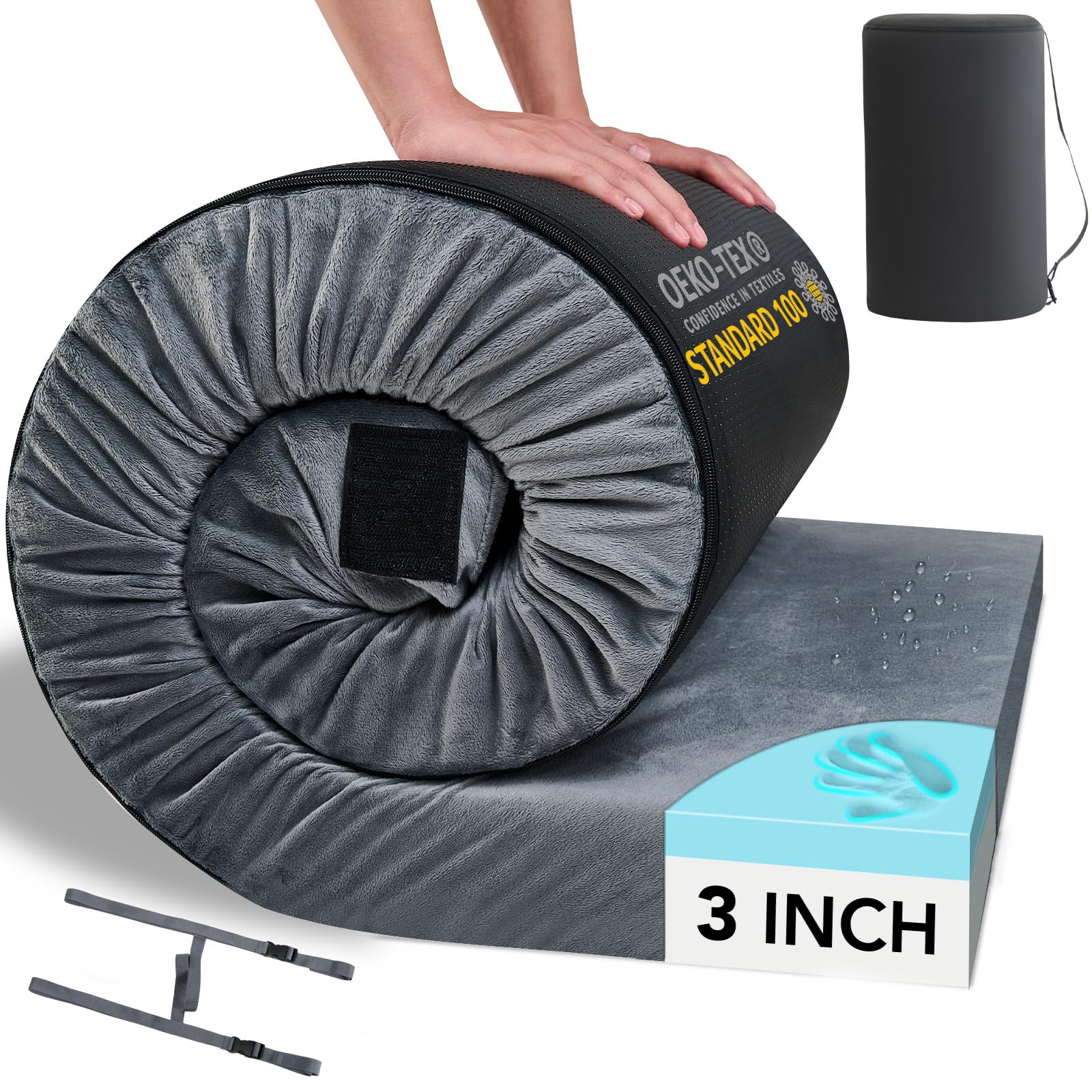
Key Features
- Loft: 3 in
- Inflation: None needed
- Insulation: Not listed
- Packed Weight: 7.8 lb roll
- Air Retention: No air to lose
- Cot Width: 24 in wide
- Price: Mid-Range
The Homemate is a practical truck-bed and cot foam pad: three inches of memory foam, a washable cover, and a price below most thicker alternatives mean comfort is the priority. The plush layer supports hips and shoulders on uneven surfaces, and the non-slip backing holds position on a cot deck. No R-value is listed, so cold-ground insulation is not specified, and the rolled size is bulky next to inflatable rivals. That limits its appeal for backpacking or winter camping, but for car-based sleepers it delivers bed-like support without needing a pump.
Pros
- Very comfortable on almost any surface, from cot canvas to truck-bed plastic.
- Strong value for a three-inch foam pad with a removable, washable cover.
Cons
- Rolling the pad back into the included sack can be difficult; the included straps make storage easier.
Best for vehicle-floor and cot sleepers who want bed-like support without inflating anything.
Best for Budget Light Camping
MOXILS Inflatable Pad

Key Features
- Loft: 3 in
- Inflation: Built-in foot pump
- Insulation: Not listed
- Packed Weight: 1.9 lb roll
- Air Retention: Leak risk reported
- Cot Width: 25 in wide
- Price: Budget
The MOXILS pad pairs a 1.9-pound build and about 3 inches of loft with a built-in foot pump, so occasional car and tent campers get a compact sleeping surface without an extra pump. Setup is quick, and the packed size slips into a gear bin or suitcase. Air retention is the tradeoff: a pad can arrive with a slow leak or lose pressure overnight, and a home leak test before the first trip is essential. This is a warm-weather pad.
Pros
- Built-in foot pump inflates the pad quickly, with no separate pump or power source to pack.
- Compact packed size fits a suitcase or gear bin, so car-camping trips stay easy to load.
Cons
- No R-value rating, so cold-ground and below-freezing trips need a more insulated pad.
For warm-weather car campers who want a light pad with a foot pump at an entry-level price, the MOXILS is a reasonable match.
How to Choose
For car camping, the biggest mistake is carrying an ultralight mindset into a purchase where thickness, insulation, and leak-free construction matter more than weight.
Loft and Thickness
Thickness is the first comfort lever. A 3-inch pad keeps hips off the ground; a 4- to 6-inch pad approaches bed-like support. Inflatable pads get loft from air pressure, foam pads from internal structure.
Inflatable loft changes with pressure; foam loft stays consistent but needs storage space. Side sleepers should target at least 3 inches, and 4 inches if they are over 200 pounds.
Inflation Mechanism
Built-in foot pumps save your breath and remove the need for a separate pump. Self-inflating foam pads often need a foot assist and a 24- to 72-hour expansion period before first use.
Foot-pump pads inflate quickly, but the valve is the most likely leak point. Self-inflating pads have fewer user-operated seals, yet they are heavier and bulkier.
Insulation and R-Value
R-value measures how well a pad slows heat loss to the ground. No listed R-value usually means mild weather only. Cold-ground campers should look for at least R-4, and below freezing R-6 or higher.
High-R-value foam is thick, dense, and heavy because insulation comes from material volume. That is a fair trade for car camping, where the carry is trunk to tent.
Weight and Packed Size
Pack size still matters for trunk and closet space. Air pads weigh 1.5 to 5 pounds; 3-inch foam pads weigh 7 to 8 pounds; 4-inch foam pads can top 11.
Lighter pads are easier to store, but they may lack the stable foam support side sleepers prefer. Decide where the pad will live between trips.
Air Retention and Valve Quality
The most common inflatable issue is a slow overnight leak from an unseated valve or a pinhole seam. Fully inflate every air pad at home and leave it for at least an hour before a trip.
Foam pads eliminate the leak-check routine. Inflatables with a repair kit are convenient, but they still need testing before you rely on them.
Width and Cot Compatibility
Most single pads are 24 to 27 inches wide. A 24-inch pad fits narrow cots but leaves gaps on a standard 30-inch cot.
A 27-inch pad fits more sleepers and most cots; a 55-inch double pad needs a tent or truck bed large enough to lay it flat. Measure your sleeping area before buying.
FAQ
Why does my inflatable camping sleeping pad keep deflating overnight?
The usual causes are an open or partially seated valve, a pinhole leak in the weld line, or a puncture that only opens under weight. Fully inflate the pad at home, wet the surface, and press around the seams to find bubbles. If the valve is the issue, close it with the base locked flat before pressing the remaining air out. Repairs are straightforward with the included patch kit, but a pad that leaks through the valve may need a replacement.
Will a 3-inch memory foam camping pad be thick enough for side sleepers?
For most side sleepers, 3 inches of dense memory foam is enough to keep hips from pressing into the ground. Lighter side sleepers will find it comfortable, while heavier sleepers or people with joint pain should move to a 4-inch foam pad for greater pressure relief. The foam also needs time to fully expand after vacuum packing; give it 24 to 72 hours before your first night.
What R-value do I need for cold-weather car camping?
For mild summer nights, an unrated pad is fine. Once nighttime temperatures drop below 50°F, look for at least R-4; below freezing, R-6 or higher is safer. The self-inflating memory-foam pads in this range claim R-9.5, which is more than enough for most car-camping conditions. A higher R-value pad will always be heavier and bulkier, but that is an easy trade to accept when you are carrying it from the car to the tent.
Can I put a memory foam camping mattress on a camping cot?
Yes, and a 3-inch foam pad can make a thin, taut cot significantly more comfortable. Use a pad that is the same width as the cot, because a 24-inch pad will leave gaps on a standard 30-inch cot. Pads with a non-slip bottom or straps stay in place better overnight. If your cot is narrower, choose a pad that matches its width.