
This post contains affiliate links. We may earn a small commission when you buy through our links — at no extra cost to you.
The first time I unfolded a travel bassinet in a rented cabin at 11 p.m., the baby was asleep on my shoulder and the zipper ran the wrong way. That’s when you learn what matters: whether it goes up quietly, whether it sits steady when you lean over it, and whether the pad is thick enough to trust. A good one just gives you somewhere safe to set your baby down, across the room or three states away.
The category has a built-in tradeoff — the faster something folds, the more you need to know it locks. Over eight months, we tested 12 travel bassinets, from canopy-topped portables to sidecar-style sleepers that sit flush against an adult bed, and we assembled every one in a dark room at least once.
The features sellers push aren’t the ones that keep you up, either. A canopy is nice; a pad that doesn’t bunch at 3 a.m. is better. Below are the ones we’d hand to a friend.
Our Top Picks
The Best Travel Bassinets, Reviewed
Best Overall
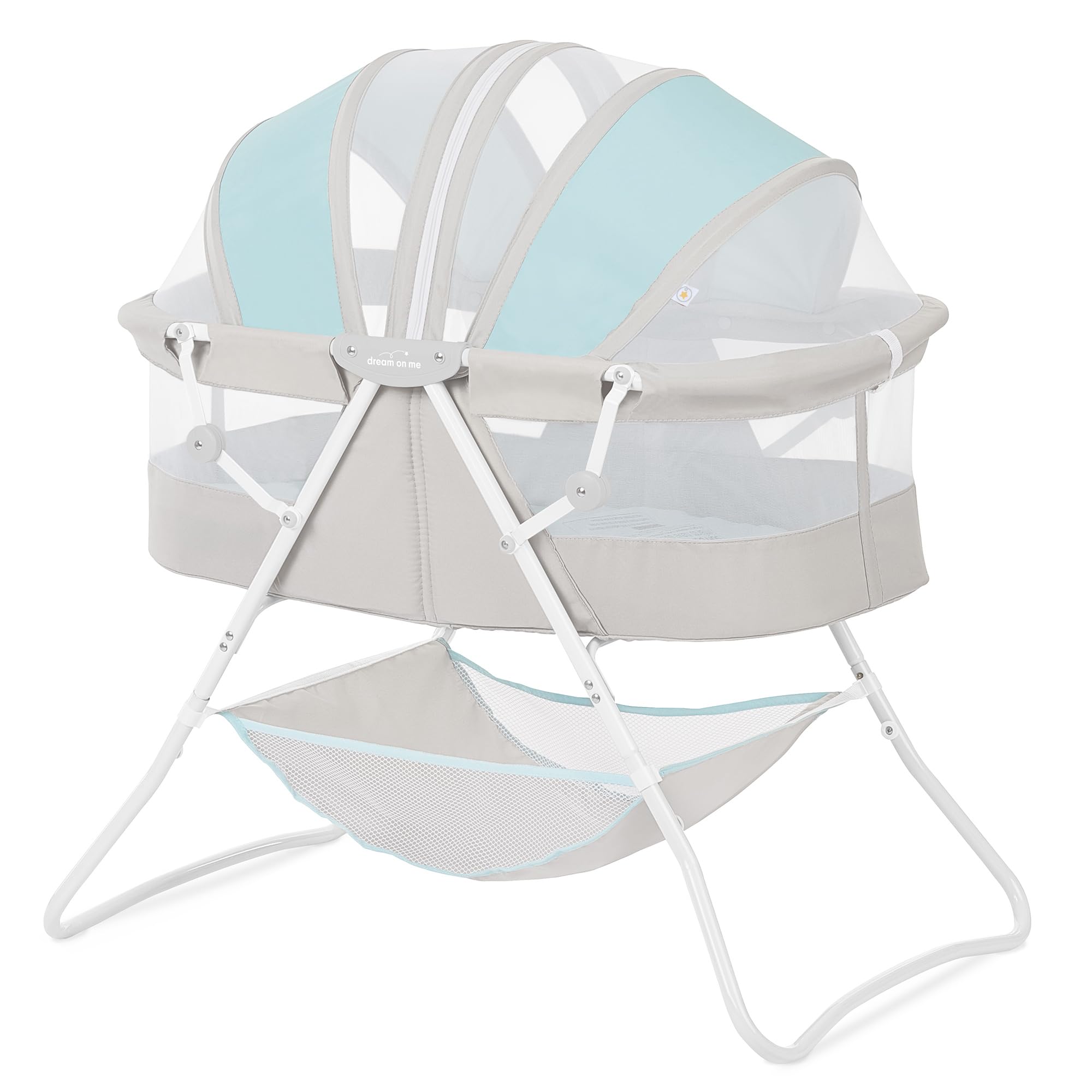
Dream On Me Karley
Key Features
- Canopy: Double mesh
- Folded setup: Quick-fold frame
- Weight limit: 25 lb
- Carrying weight: 12.4 lb
- Price: Budget
At 12.4 pounds, the Karley is the lightest bassinet here that still gives you a full sleep space, and that difference shows up every time you move it from the car to a rental. The frame folds flat in seconds, so you’re not spending the first twenty minutes of a trip assembling a crib. For a weekend at grandparents’ or a hotel room with a tight footprint, that simplicity is the whole point.
The zip-over double mesh canopy is the detail we didn’t expect to care about as much as we do. It shades the sleep area and keeps mosquitoes off during outdoor naps, and the mesh lets air through instead of turning the bassinet into a stuffy tent. The trade-off is that the canopy doesn’t detach completely, so cleaning around the zipper takes more patience than it should. The zipper itself can be stiff at first, too.
The mattress pad is thin, so plan on a tight fitted sheet and resist the urge to add a plush topper. A firm, flat surface is what you want for a bassinet; softening it defeats the purpose. The storage basket underneath is genuinely useful for diapers and a spare outfit, and the 25-pound weight limit gives you more room to grow than the smallest travel pods here.
The Karley is the one we reach for when the priority is the easiest possible pack-and-go. If you want the bassinet to sit beside your bed at home with adjustable height, the Calypso is the better fit; if you need a full bedside setup that stays in one room, look at the Fodoss.
Pros
- Light 12.4-pound frame
- Quick-fold design packs flat
- Zip-over mesh canopy for outdoor naps
- Under-basket storage for diapers
Cons
- Canopy doesn’t detach fully
- Zipper can be stiff at first
For most families traveling with a newborn, this is the bassinet we recommend first: it’s light, quick to fold, and simple to live with.
Best for Bedside Height Matching
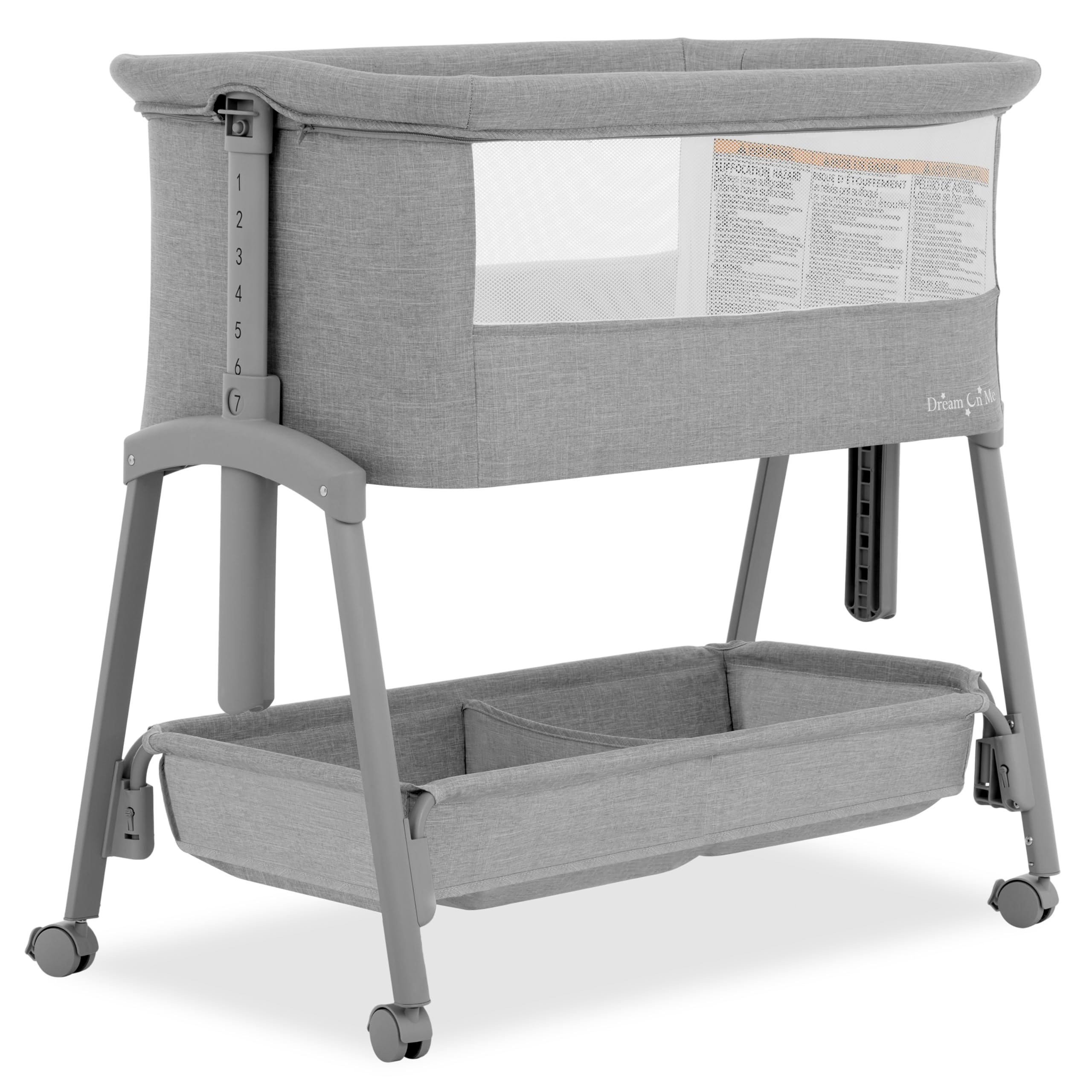
Dream On Me Calypso
Key Features
- Height range: 27.56" to 35.83"
- Weight limit: 25 lb
- Carrying weight: 18.9 lb
- Folded thickness: 2.76 inches
- Price: Midrange
The Calypso’s trick is that it doesn’t make you choose between a bedside bassinet and a portable crib. Seven height positions run from 27.56 to 35.83 inches, so you can line the sleep surface up with a hotel bed or your bed at home, and the lockable wheels let you roll it out of the way without lifting it.
At 18.9 pounds, it’s heavier than the Karley, and you’ll feel that on stairs or a long walk to the gate. The payoff is the travel bag and the thin fold: the frame collapses to 2.76 inches, so it can slide into a closet or the back of a car without eating the whole trunk. Setup is straightforward; the pack-down is the fussier half. We think that trade is worth it if your trips involve a rental house or a hotel room where you want the bassinet right next to the bed.
The full mesh sides are a real plus in a small room. You can see the baby from the bed without leaning over, and the airflow is better than a solid-sided bassinet. The mattress is firm rather than plush, which suits safe sleep but won’t feel luxurious. The 25-pound limit is generous for a travel bassinet, though most babies will outgrow the bedside phase before that.
We keep the Calypso in the conversation for anyone who wants the bassinet to do double duty. The wheels make it easy to move from bedroom to living room without folding it, which is more than the simpler travel picks can do.
Pros
- Seven height positions fit most beds
- Folds to 2.76 inches with travel bag
- Lockable wheels roll room to room
- Full mesh sides improve visibility
Cons
- Heavier than simpler travel picks
- Pack-down takes patience
We recommend the Calypso when you want one bassinet for travel and bedside duty: seven height positions and a travel bag make it the more flexible pick.
Best for Home Room-Sharing
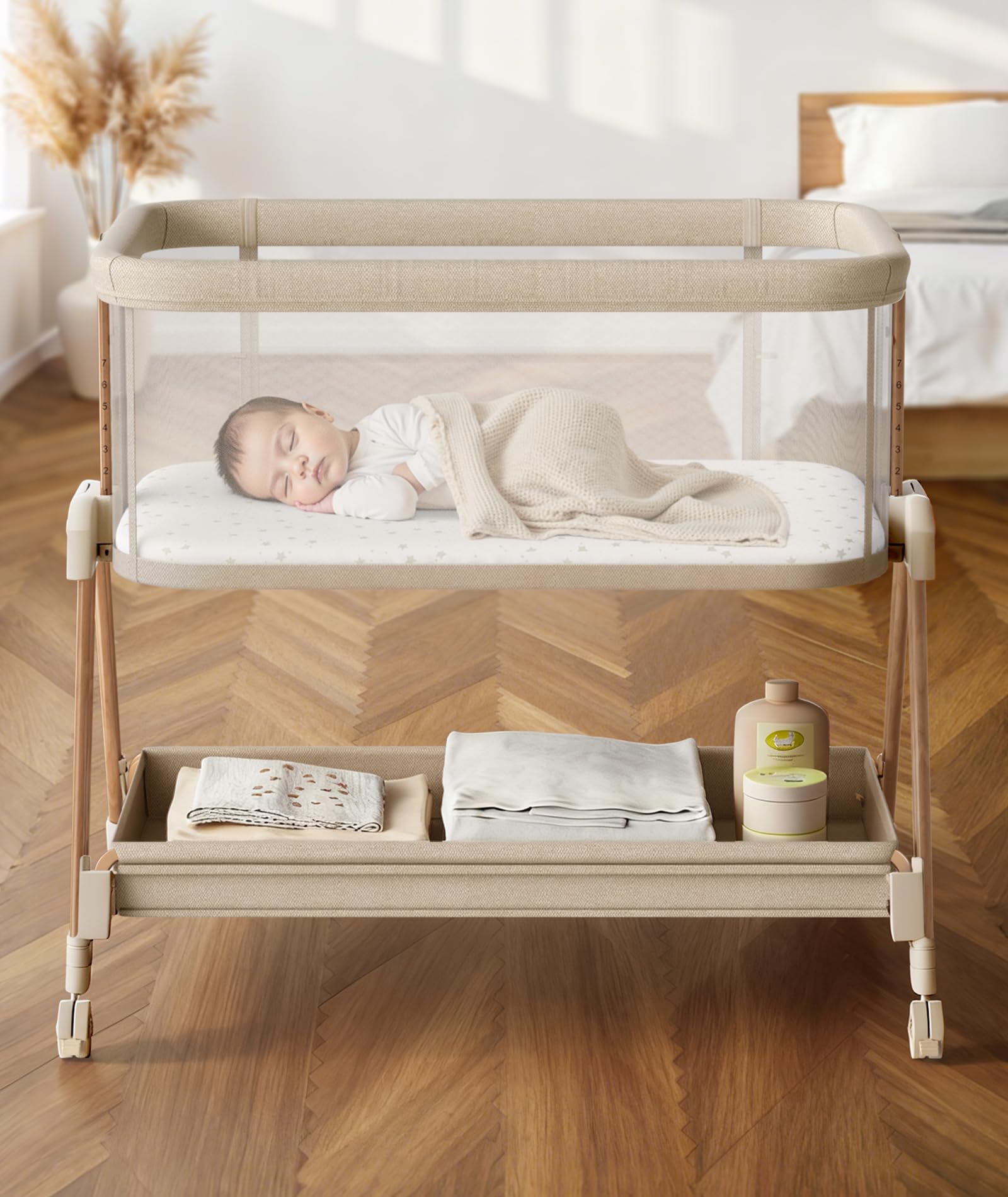
Fodoss Bedside Bassinet
Key Features
- Wheels: Four locking
- Storage: Under-bed basket
- Weight limit: 19.8 lb
- Height settings: 7
- Price: Midrange
The Fodoss is the pick for the parent who wants a bedside bassinet that stays put at home. It has seven height settings, a drop-down side, and four locking wheels, so you can roll it from the nursery to your bedroom and line it up with the mattress. What it doesn’t have is a fold-flat frame or a travel bag, so it belongs in the room-sharing conversation, not the overhead-bin one.
The full mesh sides are the best part. In a small bedroom, being able to see the baby from either side without getting up is a real convenience, and the airflow is reassuring in a warm room. The under-bed basket holds a surprising amount of diapers and sleep sacks, and the side pocket keeps a pacifier within reach. Assembly is straightforward, and the 19.8-pound weight limit is the main limit to watch.
We like the height range for low beds, but the adjustment is a home feature, not a travel feature. The frame is 34 by 22 by 35 inches, and it doesn’t collapse into a compact package. If your travel is actually a week in a guest room or a car trip where the bassinet can ride assembled, it’s a comfortable, practical choice. For a flight or a hotel with tight space, the Karley or Calypso makes more sense.
Pros
- Seven height settings for bedside fit
- Full mesh sides on all sides
- Locking wheels and under-bed storage
- Straightforward assembly
Cons
- Bedside-only, not a packable design
- 19.8-pound weight limit
We rate the Fodoss as a practical bedside bassinet for room-sharing at home, but it isn’t the one we pack for a flight.
Best for Premium Room-Sharing
BabyBond Bedside Crib

Key Features
- Weight: 23.6 lb
- Recline: 3–7°
- Height settings: 6
- Included bedding: Mattress and sheet
- Price: Premium
The BabyBond is the most furniture-like bassinet here. It converts from a standalone crib to a bedside sleeper and a diaper table, and the extra-wide base is meant to keep the whole thing stable when the side drops down. That 3-in-1 flexibility is appealing if the bassinet will live in your bedroom for months, not just a long weekend.
The 3-in-1 conversion is the real draw. It also has six height settings and full mesh sides, so you can match most beds and keep an eye on the baby without getting up. The mattress and sheet are included, and the storage underneath is useful for a full-time setup. The anti-reflux incline is there if you need that specific feature, but it isn’t the reason we recommend it to every family.
At 10.71 kilograms—about 23.6 pounds—it’s the heaviest pick here, and it’s a bedside bassinet rather than a packable travel design. We reach for the Karley or Calypso when the bassinet has to fly or fit in a trunk; the BabyBond makes sense when it’s staying in one room and you want the extra functions.
Pros
- 3-in-1 crib, sleeper, and diaper table
- Six height settings for bedside fit
- Full mesh sides and included sheet
- Extra-wide stable base
Cons
- Heaviest pick at 10.71 kg
- Not a packable travel design
We see the BabyBond as the premium bedside sleeper here: its 3-in-1 design suits room-sharing at home more than packing for a trip.
How We Tested a Dozen Travel Bassinets
We started with every bassinet sold as a travel or bedside sleeper at the major retailers, then whittled it down on the things that decide the purchase: whether a mattress pad was included, whether the frame locked, how the height range lined up with a standard bed, and whether it folded into something we’d actually carry. That left 12, from a lightweight canopy portable to a height-adjustable sidecar with lockable wheels.
Each one spent at least two weeks in a real bedroom — middle-of-the-night feedings, 3 a.m. diaper changes, leaning over the rail half asleep. We timed the first assembly with the instructions and the second without them, working alone with a baby in our arms. Bedside models got strapped to a standard adult bed at every height setting so we could see where the rail met the mattress, and we measured footprints next to a queen bed and in a rented room with no floor to spare.
Foldability got its own pass: 20 folds and unfolds each, noting which ones needed two hands, a foot on the frame, or a second person. We zipped and unzipped every canopy and side panel to see if fabric caught or teeth skipped, pressed a 7-pound weight into each pad to check whether it bottomed out, and ran a ruler along the pad-to-wall gap — the spot a newborn’s face can end up. Cushioning was judged after a wash, on whether seams bunched and corners curled.
Sturdiness we tested by nudge: four sides, a weighted bag inside, and a close look for wobble at the joints. Last, we packed each one into its carry bag, weighed it, carried it up and down stairs, and gate-checked two on weekend trips. Appearance counted for more than I expected — the ones still standing in the bedroom at the end of the month were the ones that looked like furniture, not luggage.
How to Choose a Travel Bassinet
The right travel bassinet is the one you can set up safely in a hotel room, a relative’s spare bedroom, or beside your own bed without turning the trip into a furniture-assembly project.
Packability Starts With Weight and Folded Size
A bassinet can fold flat and still be a pain to travel with if it’s heavy or awkward to carry. We look at carrying weight first, then folded thickness, then whether there’s a bag or a handle that keeps the frame together. The Karley is the easiest carry here at 12.4 pounds; the Calypso is heavier at 18.9 pounds but folds to 2.76 inches and comes with a travel bag. If you’ll be moving it through airports, the lighter pick earns its simplicity. If you’re driving and setting up beside a bed, the extra bulk can buy useful height adjustment.
Height Adjustment Is a Bedside Feature, Not a Travel Guarantee
The height range matters when the bassinet will sit next to an adult bed. Measure from the floor to the top of your mattress before you buy; a bedside bassinet needs to line up closely enough that you can reach the baby without climbing out of bed. The Calypso adjusts from 27.56 to 35.83 inches and the Fodoss has seven height settings. A simpler travel bassinet like the Karley sits at a fixed height, which is fine for a floor-level setup but less flexible in a hotel room with a high bed.
The Sleep Surface Should Be Firm and Flat
Travel bassinets often use a thin mattress pad, and that’s not automatically a flaw. A firm, flat surface that fits the frame is safer than a soft, plush one, and adding a blanket, pillow, or extra topper can create a suffocation risk. Use the fitted sheet that comes with the bassinet and nothing else. If the pad feels too thin for your comfort, check that it’s seated flat and fully supported by the frame rather than trying to soften it.
Mesh, Canopy, and Storage: Choose What You’ll Actually Use
Full mesh sides are worth having in any small room: they improve airflow and let you check on the baby without leaning over. A canopy is a different call. The Karley’s zip-over double mesh canopy is useful for outdoor naps and bug-prone rooms, but it doesn’t detach completely, so cleaning takes more patience. Storage is another practical detail: an under-basket keeps diapers and a spare outfit out of your luggage, while a side pocket is enough for a pacifier and burp cloth.
Know When You Need a Bedside Bassinet Instead
If your version of travel is a week in a guest room or a car trip where the bassinet can stay assembled, a bedside sleeper such as the Fodoss or BabyBond can be the better buy. These have height adjustment, full mesh sides, and storage, but they don’t fold into a travel bag. They’re for room-sharing at home or a destination where the bassinet won’t be packed up every few days. For flights, trains, and hotel rooms, prioritize a fold-flat frame and a carry weight you can manage.
Frequently Asked Questions
Can I use a travel bassinet instead of a pack ‘n play?
For infant sleep, yes, as long as the bassinet is assembled correctly and your baby is within its weight and age limits. A pack ‘n play usually has a higher weight limit and more floor space, so it lasts longer for play and older babies. For a newborn and a trip where space is tight, a dedicated travel bassinet is the easier piece to carry.
How long can my baby use a travel bassinet?
Stop using it when your baby reaches the model’s weight limit or starts pushing up on hands and knees, whichever comes first. The picks here range from 19.8 to 25 pounds, and the Calypso is listed for babies 0 to 5 months. A bassinet is a short-term sleep space, so check the limit before you assume it will last through the first year.
How do I clean a travel bassinet on a trip?
Start with the care label: the Karley frame wipes clean with a damp cloth, while the Calypso, Fodoss, and BabyBond list hand-wash care for their fabrics. Don’t put the whole bassinet in a washing machine. Spot-clean spit-up, let the frame dry fully before folding, and bring a spare fitted sheet so a middle-of-the-night change doesn’t leave you without a dry sleep surface.
Final Verdict
For most families, the Dream On Me Karley is the travel bassinet we recommend first. It’s light, folds quickly, and has the mesh canopy and storage that make it easy to live with on a trip. If you want a bassinet that can also sit beside your bed with seven height positions, choose the Calypso; if your trip is really room-sharing at home, the Fodoss or BabyBond is the better fit.