
This post contains affiliate links. We may earn a small commission when you buy through our links — at no extra cost to you.
Every pack and play ships with a mattress, and nearly all of them feel like a padded board. You can feel the frame under your knuckles, your baby wakes an hour into a nap at Grandma’s, and the sleep-on-the-go promise quietly stops working. A proper mattress or topper fixes it, provided it hugs the standard 38-by-26-inch floor with no gaps at the corners. Thickness is where most shoppers misjudge: too little and you’ve gained nothing, too much and the sleep surface sits higher than the playard was built for.
We’ve spent six months with 12 of them, from thin pads to three-inch memory foam, and the differences show up fast. Some foam stays flat under a knee; some dents by week three. A few flip between a firm infant side and a softer toddler side, which is worth knowing before you buy twice. The ones with a carry bag or a trifold fold also travel far better than the ones you wrestle into a closet. The picks below are the ones that held up, and they aren’t all for the same family.
Our Top Picks
The Best Pack ‘N Play Mattresses, Reviewed
Best Overall
Hiccapop Playard Mattress Pad
Key Features
- Cover: Waterproof, machine washable
- Weight: 2.5 lb
- Thickness: 1.25 inches
- Dimensions: 38" x 26"
- Price: Midrange
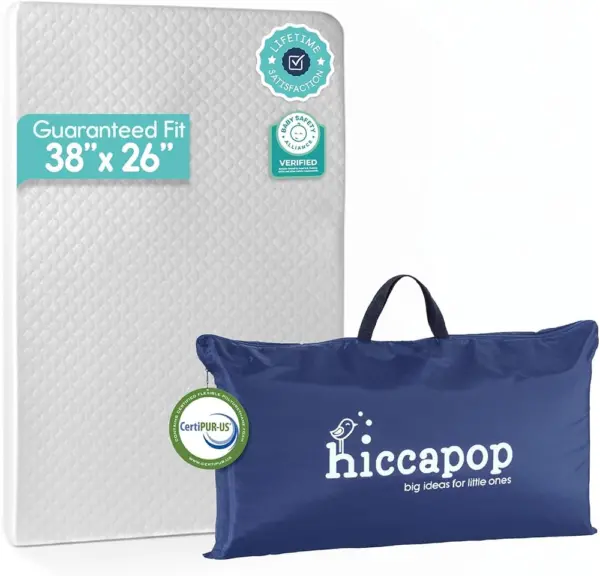
Pull it out of the box and the first thing you notice is the weight — 2.5 pounds of three-layer polyurethane foam, 1.25 inches thick, with rounded corners cut to drop into a 38-by-26 playard floor. What it replaces is the thin panel that comes with the playard, closer to a padded sheet than a mattress, and the difference shows up the first night a baby sleeps on it.
We recommend this one to most families because it keeps working as the baby grows. The foam is two-sided: a firmer face for the newborn months, a softer one once your child is sitting up and rolling, so a single pad covers the whole span the playard gets used instead of two. The jacquard cover has a waterproof backing and zips off for the machine, which matters more than any comfort claim once a stomach bug comes through the house.
Go in expecting a firm 1.25 inches, not a plush surface. That’s the point — it adds cushioning without lifting your baby far off the playard floor, and it stays flat with no dip where a toddler sits down hard. If you’re picturing something closer to a bed mattress, one of the three-inch picks below is what you actually want, and you should check your playard’s thickness limit before you buy one.
A standard crib sheet stretches over it, so you don’t have to hunt down playard-sized bedding — a small convenience that turns out to matter at the end of a long day.
Pros
- Reversible firm and softer faces
- Waterproof cover zips off for machine washing
- Snug 38 x 26 fit with rounded corners
- Carry bag included
Cons
- Does not fold or roll for packing
We point most families here: two-sided foam that follows a baby from newborn to toddler, a waterproof cover that goes in the wash, and a snug fit with no gaps.
Best Budget
Sleepah Pack and Play Mattress
Key Features
- Cover: Waterproof, removable, hand wash
- Includes: Fitted sheet
- Dimensions: 38" x 26"
- Certifications: CertiPUR-US, OEKO-TEX
- Price: Budget
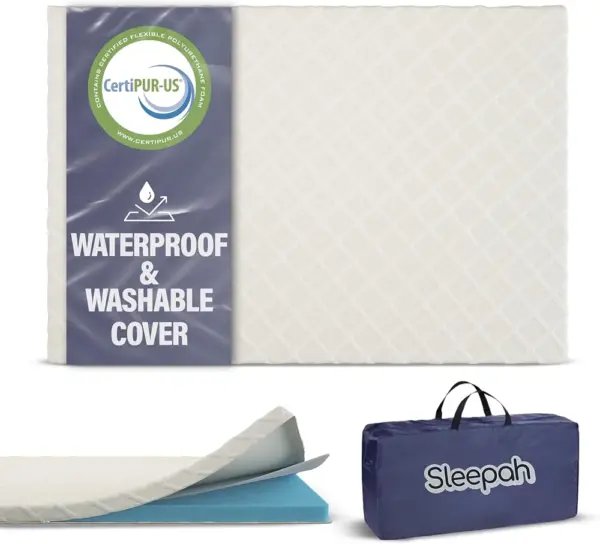
This is the least expensive pad in the group, and it is the one we point people toward for a second playard — the grandparents’ house, the sitter’s living room, the setup that gets used a few weekends a year. It measures 38 by 26, uses CertiPUR-US foam with OEKO-TEX certification on the fabric, and comes with its own fitted sheet, so you aren’t buying bedding on top of the pad.
Know what you’re getting. The foam is firm and flat with very little give, closer to a firm crib mattress than to a topper, which is exactly right for a newborn and less appealing once a two-year-old is sleeping on it. It also ships compressed and takes about a day to reach full size, so don’t judge the thickness in the first hour.
Where it stops making sense is a nightly sleeper. There’s no dual-sided foam and no carry bag, and the foam will not soften for a toddler the way a two-sided pad does. This is a pad for occasional nights, and at that job it’s hard to argue with.
Pros
- CertiPUR-US foam and OEKO-TEX fabric
- Comes with a fitted sheet
- Waterproof removable cover
- Lowest price in this group
Cons
- Cover is hand wash only
Our budget pick: a certified 38-by-26 pad with a waterproof cover and a fitted sheet in the box, for the least money in this group.
Best for Travel
Babylicious Trifold Topper
Key Features
- Design: Trifold with carry bag
- Weight: 3 lb
- Dimensions: 38" x 26"
- Certification: CertiPUR-US foam
- Price: Midrange
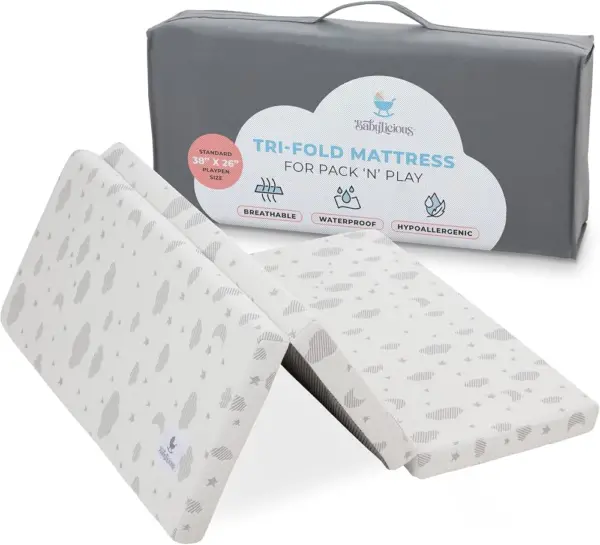
Fold it once and it’s a wedge, twice and it’s a flat case about the size of a briefcase: three hinged panels of CertiPUR-US foam, 3 pounds total, with a handle and a zip bag. That’s the whole argument for this pad — it comes out of a trunk and into a playard in about ten seconds, and it goes back the same way.
The fit is the part that matters and it holds up: 38 by 26 with rounded corners, no gap at the edges in a standard playard. The cover is a waterproof jacquard that zips off for the machine, and the foam is firm enough to count as a legitimate infant sleep surface rather than a pillow.
Where it lands for us is the travel pad. It is a topper more than a mattress, and the 1.5-inch figure is a ceiling rather than a promise — the padding is the thing to weigh against a fixed pad that stays home. For a weekend at Grandma’s, folding wins, and the firmness is genuinely there on the first night.
Pros
- Folds flat into thirds with a carry bag
- Waterproof cover zips off for machine washing
- Firm CertiPUR-US foam, not a pillow
- Snug 38 x 26 fit with rounded corners
Cons
- Padding runs thinner than the stated 1.5 inches
We buy this one for the road: it folds flat, weighs three pounds, and gives a travel playard a firm, waterproof sleep surface instead of the stock panel.
Best Full-Thickness Pad
Lilian&Gema Pack and Play Mattress
Key Features
- Weight: 3 lb
- Firmness: Medium
- Dimensions: 38" x 26" x 1.5"
- Certifications: CertiPUR-US, ASTM F2933-21
- Price: Midrange
One and a half inches is the most padding you can add to a playard before the sleep surface starts climbing toward the top rail, and this pad actually delivers it — 3 pounds of high-elasticity foam cut 38 by 26 with rounded corners, plus a cover that’s waterproof, removable and machine washable.
The listing tells you to measure your playard before ordering, and a tape measure is the right tool: it fits most standard playards snugly, but interiors vary by a quarter inch or so between brands. Foam feel is medium — more give than the firm 1-inch pads, less than memory foam — so it’s a better fit for a toddler than for a newborn. It arrives vacuum packed, so give it a day before you decide anything.
Pros
- Delivers a true 1.5 inches of foam
- Cover is waterproof and machine washable
- CertiPUR-US foam and ASTM F2933-21
- Light enough to carry by the handle strap
Cons
- Medium foam, softer than a crib mattress
If you want the full 1.5 inches rather than a thin topper, this is the pad we name: certified foam, a machine-washable cover, and a snug fit.
Best for Toddlers
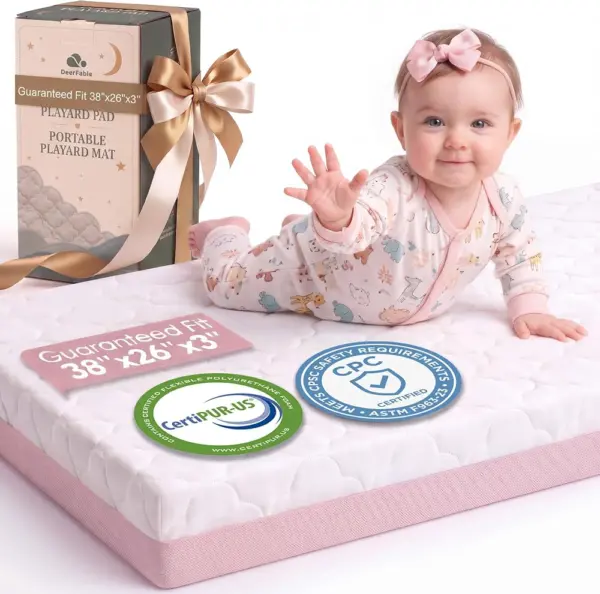
DeerFable Dual-Sided Mattress
Key Features
- Cover: Waterproof, machine washable
- Firmness: Dual sided
- Dimensions: 38" x 26" x 3"
- Construction: 8 layers
- Price: Premium
This one is a mini crib mattress that happens to be cut to playard size. Eight layers of memory foam, 3 inches thick, 3.7 pounds, in white and pink — the build is closer to a real crib mattress than to the foam pads that make up most of this list, and you can feel the difference at the edges, where it doesn’t sag away under a hand.
It’s also the only pick here with two firmness levels built in on purpose: a firm face and structure for the first year, then a softer face and a cooler fabric for the toddler stretch, which the maker frames as one mattress from birth to about age three. The waterproof membrane sits inside the cover rather than on top of it, and the whole cover is machine washable.
Three inches is the catch. It sits well above the 1.5-inch ceiling that most pads here stay under, so the sleep surface ends up high inside a playard. Check what your playard’s manual says about maximum mattress thickness, and set it in place to confirm the top of the pad stays below the top rail with no gap. Used the way it’s designed — as a mini crib mattress or a floor-level bed for an older toddler — that concern doesn’t apply.
Where it earns the premium is a two-year-old using the playard as a bed rather than a travel cot. A child who has outgrown a 1-inch pad gets real support here, and the washable cover survives the years when a diaper leak is a weekly event. It is the most mattress you can put in a playard, and it’s priced accordingly.
Pros
- Dual firmness from newborn through toddler
- Three inches of genuine support
- Waterproof cover is machine washable
- Fits mini cribs as well as playards
Cons
- Most expensive pad in this group
For a toddler who sleeps in a playard every night, this is the pick: three inches of dual-firmness foam and a washable waterproof cover.
Best for Firm, Minimal Padding
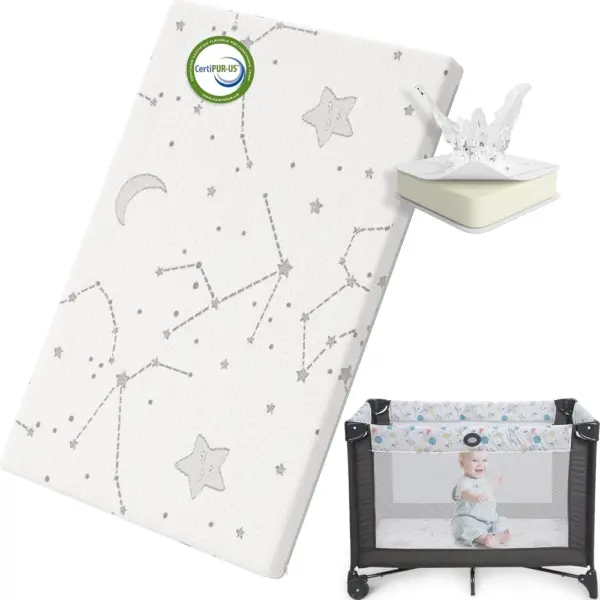
YENING Pack and Play Topper
Key Features
- Weight: 2.2 lb
- Firmness: Firm
- Dimensions: 38" x 26" x 1"
- Certification: CertiPUR-US foam
- Price: Budget
If you want the playard floor to feel barely changed — softer, flatter, less like a board — this is the pad we hand over. One inch of firm CertiPUR-US foam cut 38 by 26, with a waterproof cover that wipes clean. It does the minimum job properly and doesn’t pretend to be a mattress, which is a compliment in a category full of pads that do.
For a newborn, that firmness is the point: a firm, flat surface is what an infant should be sleeping on, not a soft one, and the foam here has almost no give under a knee. The cover is removable, the fit is consistent across standard playards, and the whole thing weighs about 2.2 pounds. It ships rolled and compressed, so give it a day to flatten before you judge it.
Pros
- Firm, flat surface suited to newborns
- Waterproof removable cover
- CertiPUR-US certified foam
- Low price for a certified pad
Cons
- Too little padding for an older toddler
Our pick for a firm, barely-there pad: one inch of certified foam that flattens a playard floor without changing how the playard works.
Best for Bedroom Playards
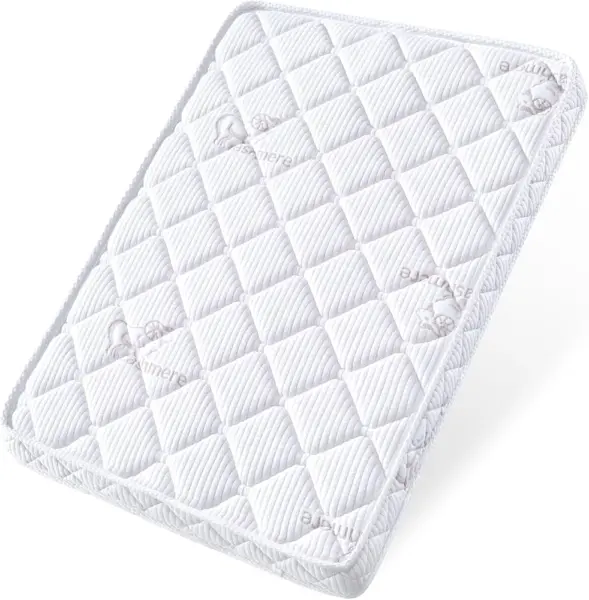
OSSERTSbearY Playard Mattress
Key Features
- Cover: Knitted cotton blend
- Weight: 4 lb
- Firmness: Medium
- Dimensions: 38" x 26" x 1.5"
- Price: Midrange
Noise is what separates a pad a baby will sleep on from one they keep waking up on: a crinkly foam core or a plasticky liner rustles every time they shift. This one has neither — high-density foam under a knitted cotton-blend cover, with nothing between them to make a sound, which is the first thing a light sleeper in a small apartment will thank you for.
The rest of the spec sheet is straightforward: 38 by 26, 1.5 inches, medium firmness, 4 pounds, with a non-slip base and reinforced stitching at the seams. It’s sized for Graco, Baby Trend and Pamo Babe playards, and the corners sit down where they should instead of curling up at the edges.
It’s also built to keep the factory smell down, which is not nothing. Foam pads usually arrive needing two days by an open window before a baby goes near them, and this one is made to a standard that targets exactly that. Give it a few days to expand fully regardless, since the foam is compressed hard for shipping.
Where it fits: a playard that lives in a bedroom and gets used every night, where quiet matters more than folding into a bag. It’s the pad that stays set up, and the four pounds of foam are why it doesn’t slide around when a toddler climbs in.
Pros
- Silent, with no crinkle when a baby moves
- Non-slip base keeps it in place
- Full 1.5 inches of high-density foam
- Built to a low-odor standard
Cons
- Cover has no waterproof backing
The quiet one: a 1.5-inch pad with a soft knit cover and a non-slip base, built for a playard that lives in the bedroom and gets used nightly.
Best for Traveling Toddlers
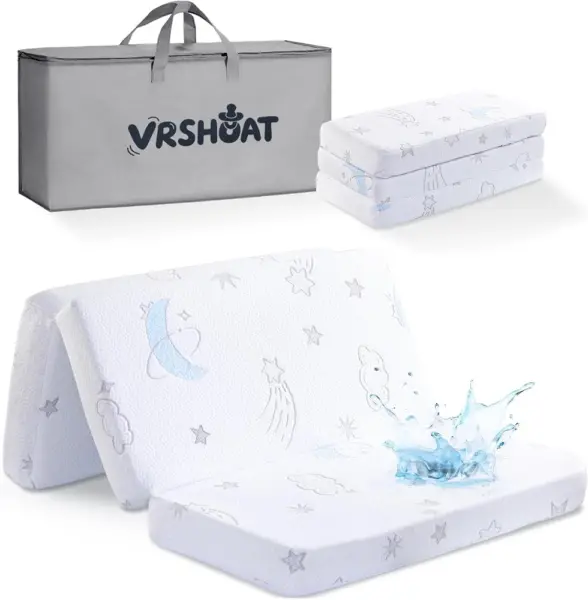
VRSHOAT Trifold Mattress
Key Features
- Design: Trifold with carry bag
- Weight: 4.5 lb
- Dimensions: 38" x 26" x 3"
- Certifications: CertiPUR-US, ASTM
- Price: Midrange
Three inches of foam and a tri-fold hinge in the same product — that combination is rare in this group, and it’s the reason this pad exists. It stands as tall as the DeerFable at roughly half the price, minus the memory foam and the eight-layer build, which is a trade plenty of families will happily make.
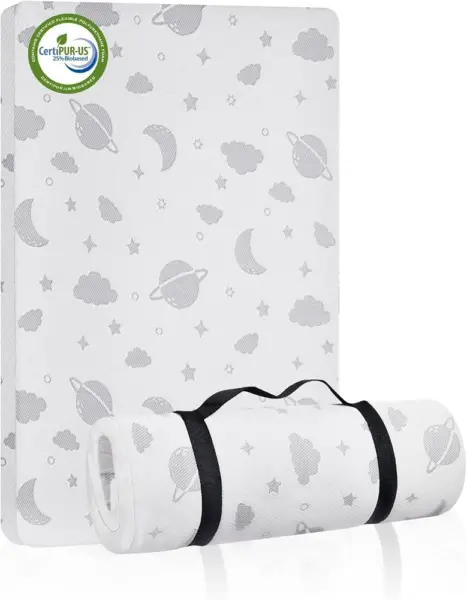
What we appreciate about how it’s put together: each of the three sections is encased separately, so the foam doesn’t migrate under a knee when a toddler climbs in, and the waterproof cover zips off and goes in the machine. Folded, it goes into the included bag with a handle — 4.5 pounds, carryable in one hand along with a diaper bag.
Buy it for a toddler who travels. The cushioning is real, the fold makes it packable, and the foam is certified to CertiPUR-US and ASTM standards rather than just described as safe on the box. For a child old enough to sleep on the playard floor, it’s the most comfortable thing here that also fits in a car.
Pros
- Tri-folds into an included carry bag
- Three inches of certified foam
- Sections encased separately
- Waterproof cover is removable
Cons
- Tall enough to raise the sleep surface
The thick pad that folds: three inches of certified foam for a toddler who needs real cushioning and a trunk that needs the space back.
How We Tested Pack and Play Mattresses
We started by pulling every mattress, pad, and topper sized 38 by 26 inches, the footprint that fits standard playards, then filtered out anything without a removable washable cover, anything that needed its own crib frame, and anything priced like a full-size crib mattress. That left 12 units, which we rotated through real playards over six months.
Testing happened where these actually live: the playard in the corner of a nursery, a second one at my mother-in-law’s house, a hotel room on a weekend trip, and the back of a packed car. I measured each one with a tape against the playard floor and pressed both fists into the center to feel for the frame underneath, then checked the corners for gaps wide enough to trap a limb. Thickness got its own pass, noting how high each surface sat relative to the playard wall and whether a standard sheet still stretched over it.
Every mattress spent at least a week of naps under a baby, and we logged how quickly she settled and whether she woke up on the hard spots. Softness we judged by hand before a baby ever touched it, then again after a month of use, since a topper that felt plush on day one but flattened by week four didn’t score well. Covers went through three home washes; we spilled water and juice on each to see whether it beaded or soaked through, then checked seams and foam for curling afterward. Portability meant folding, bagging, and carrying each one out to the car. Value came down to what shipped in the box, a removable cover, a carry bag, foam certifications, set against the price tier each one played in.
How to Choose a Pack ‘N Play Mattress
The panel that ships with a playard is a floor board, and replacing it is the cheapest sleep upgrade in the nursery — as long as the new one sits flat, fits snug, and doesn’t lift your baby higher than the playard allows.
Thickness: More Is Not Automatically Better
Nearly every pad in this guide tops out at 1.5 inches, and the two that reach 3 inches are built as mini crib mattresses first. The ceiling exists because thickness raises your baby’s sleep surface inside the playard, closer to the top rail, and a soft, overstuffed edge is the opposite of the firm flat surface an infant needs.
Before buying above 1.5 inches, check the playard manual for a stated maximum playard mattress thickness and set the pad in place to see where the surface lands with no gap at the sides. A 3-inch pad is a reasonable choice for a two-year-old on the floor of the playard; for a newborn, stay at 1.5 inches or less.
Fit: Measure the Floor, Not the Box
Everything here is sold as 38 by 26 inches, the nominal playard floor, but interiors vary by a quarter inch or more between brands. A pad that is slightly small leaves a gap at the edge where a baby’s face can wedge, and that gap is the failure mode worth caring about.
Measure the inside of your playard before ordering, corner to corner both ways. Rounded corners are a feature, not a styling choice: they let the pad settle into a rounded playard floor instead of buckling at the seams. A quarter inch of slack is fine. An inch is not.
Firm for a Newborn, Softer for a Toddler
A firm, flat surface is what an infant should sleep on, which is why the pads here read as firm rather than plush. The tension shows up around the first birthday, when the same baby wants some give under a hip and a shoulder.
Two-sided pads solve that: firm face for the first months, softer face after. If you’re buying one pad to last through the playard years, pay for the two-sided one. If you’re buying for a newborn only, a single firm face is all the pad needs to do.
The Cover Is the Part You’ll Actually Maintain
Waterproof matters more than softness. A cover with a waterproof backing keeps milk and leaks out of the foam; a knit cover without one sends them straight in, and soaked foam is difficult to rescue. A waterproof sheet over the top buys you time either way.
Zip-off, machine-washable covers are worth paying for. Hand-wash-only covers get washed less often than they should, and this is a surface a baby spends twelve hours a day on. Check the care instructions before you check the thread count.
Folding, Rolling, or Staying Put
Folding pads cost more for the same foam because of the hinge and the bag, and that money is well spent only if the pad leaves the house. A flat pad that lives in the playard, wears a stretched sheet, and never moves doesn’t need to fold — and flat pads tend to fit more snugly because there is no seam running across the sleep surface.
Buy the fold if the playard travels to grandparents, hotels, or daycare. Skip it if the playard stays in one room, and put the savings into a better cover.
Frequently Asked Questions
Can I use a regular crib mattress in a Pack ‘n Play?
No. A standard crib mattress is 52 by 28 inches and a playard floor is 38 by 26, so a crib mattress doesn’t drop in — it sits on top of the frame, which leaves exactly the kind of gap you’re trying to avoid and puts the sleep surface far too high.
A playard needs a playard-sized pad with rounded corners. That’s why every pick here is cut to 38 by 26.
Do these pads need special sheets?
Most take standard 38-by-26 playard sheets. A crib sheet will also stretch over a pad that is 1 to 1.5 inches thick, which is useful on vacation when the right size stayed home.
If the pad’s own cover is a knit without a waterproof backing, add a waterproof sheet on top — it costs far less than replacing foam that has absorbed a leak.
How long does the foam take to reach full size?
Most of these ship vacuum packed and reach full size within a day; the denser 1.5-inch pads can take three to five. Lay the pad flat, give it the time, then measure the thickness with a ruler.
If it is still short of the stated figure after a week, that’s a return rather than something to live with.
Final Verdict
For most families the Hiccapop is the answer. It gives you a firm newborn face and a softer toddler face in one pad, a waterproof cover that goes in the machine, and a snug 38-by-26 fit that leaves no gap — cheaper than buying a firm pad now and a softer one eighteen months later.
If the playard is a second setup that gets used a few weekends a year, the Sleepah does the same job with a fitted sheet in the box for less. If a toddler sleeps in the playard every night, step up to the DeerFable‘s three inches and check your playard’s stated thickness limit first.